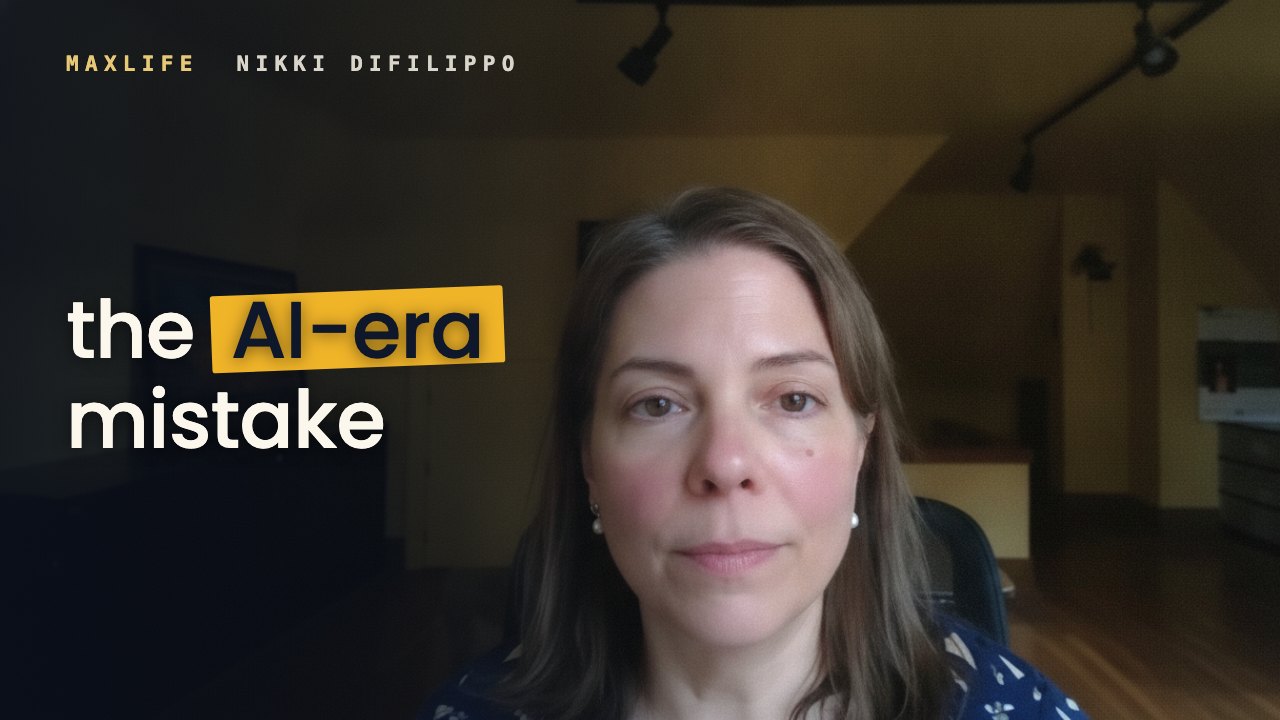
Why AI-generated content is hurting B2B startup marketing
The promise of AI in marketing is speed. The problem is that every competitor has the same speed. Nikki DiFilippo opens the conversation with a line that sets the tone for the whole episode: "There's just too much noise and the noise is just getting started." When every founder can spin up blog posts, LinkedIn updates, and cold email sequences in minutes, the channels fill faster than buyers can process them. The result is not more reach. It is more friction.
Nikki has watched technology markets flip before. She was in the room when Charles Stack launched books.com in 1991, the first internet bookstore, three years before Amazon. She watched banks refuse to fund an online bookstore because they could not picture what online meant. That experience taught her to read inflection points, and she reads this one clearly: the sheer volume of AI-generated content is about to force a structural change in how B2B marketing works.
B2B startup positioning when everyone publishes at scale
Nikki's definition of marketing has stayed consistent across three decades: "Finding the right product for a company that provides them with the greatest benefit." What has changed is that positioning now has to do more work. When content is abundant, clarity is scarce. The startups that cut through are the ones that can say, with precision, exactly who they help and exactly what problem they solve.
This is where she sees founders struggling most. They adopt AI tools quickly, let the output go out unedited, and end up sounding like every other company in their category. Sounding human is now a deliberate strategy. Nikki's approach is to identify two or three people who write exceptionally well, then prompt AI to match their voice and tone. The output is still fast. It just does not read like a press release written by a committee.
The inbound reversal: how startup lead generation may change
The most forward-looking idea in this episode is one Nikki says she had not fully articulated before the conversation. She sees the current outbound-heavy model breaking down under the weight of its own noise, and a reversal taking shape: "I almost see potential customers or prospects posting problems and having it reversed so that the right information or the right products can come to them at the right time."
In this model, the marketing skill shifts. It is less about broadcasting and more about having language precise enough to be recognized when a buyer surfaces a specific problem. The startup that wins is not the loudest. It is the one whose positioning maps cleanly onto the language a buyer uses when they are ready to ask for help. Nikki frames this as a potential new market in itself: helping customers define their problem clearly enough that the right solution can find them.
Prompt engineering as a core startup growth skill
Nikki is direct about what separates founders who get real value from AI and those who get generic noise: prompt engineering. She draws the analogy herself. Asking for better health is too broad. Asking for a specific outcome, with specific parameters, in a specific timeframe, produces something actionable. The same logic applies to every AI-assisted marketing task.
She recommends staying current through organizations like themarketinginstitute.com, which she describes as doing the research legwork on tools that change every three months. The tools she is currently using include ChatGPT, Perplexity, Claude, Dripify for LinkedIn outreach, and SmartLead for lead generation. The tools matter less than the habit of testing them with intention.
What growing up first-generation taught her about startup grit
Nikki's parents immigrated from a 500-person hill town in Italy. Her mother's advice was simple: "We can't really help you. We don't know how this culture works. You need to figure it out." That go-figure-it-out orientation, combined with a Cleveland upbringing in a city that has had to reinvent itself repeatedly, produced the self-reliance that eventually made starting her own company feel natural rather than risky.
She did not plan to go out on her own. She got laid off, went to Italy for a month, and came back to find three former partners asking her to consult. She stopped looking for a job. Via Vera Group, whose name means the true way in Italian, grew from there, primarily through word of mouth.
Human connection as the long-term competitive advantage
Nikki is an early adopter who genuinely loves technology. She is also clear-eyed about what it cannot replace. "Technology is making the world connected but yet disconnected," she says. Her answer to the question of what it means to be human in five to ten years is not philosophical. It is practical: share a meal, go on a hike, have a glass of wine with people you care about. Proactively protect the relationships that AI cannot simulate. That is not a retreat from the future. It is the foundation that makes everything else sustainable.