MaxLife Podcast · Episode

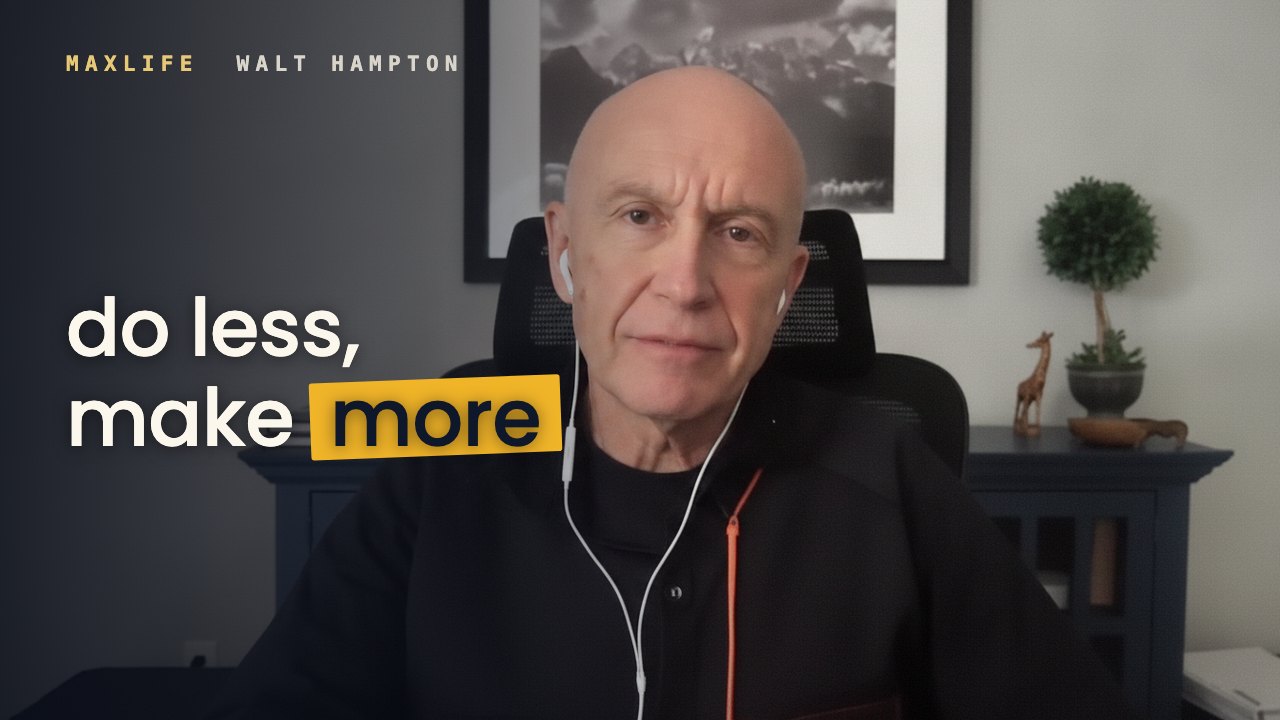
Do Less, Make More: Walt Hampton’s System for Time Freedom & Peak Performance

What if the reason you're out of time has nothing to do with your calendar? Walt Hampton, mountaineer, former managing partner, and elite business coach, breaks down the system he's used for decades to help entrepreneurs do less, earn more, and finally live on their own terms.

With Walt Hampton1h 31mTime Mastery · Entrepreneurship · Peak Performance
The short version

Most entrepreneurs don't have a time problem, they have a clarity problem. Walt Hampton, bestselling author and high-altitude mountaineer who spent 25 years as a managing partner before building a global coaching practice, argues that time can't be managed, only chosen. The real work is getting ruthlessly clear on what you want and why, then building the structures and boundaries that protect it. His framework starts with three questions: What do I want? Why do I want it? What is one step I can take right now? From there, discipline creates freedom, 'no' becomes a full sentence, and the how-to question stops being a smokescreen for fear. The result isn't just a better schedule, it's a life that actually feels like yours.

Key moments
What you'll take away

9 ideas from this conversation

01

Time can't be managed

Walt is direct: 'Time just is.' What you can manage is how you show up within it, and that starts with a choice, not a calendar.

02

Clarity before strategy

Before any system, Walt asks clients to write 2,000 words on why this business matters. Without a strong why, every hard day becomes a reason to quit.

03

No is a full sentence

Once you know what you really want, the most important skill in time mastery is saying no to everything that doesn't serve it, without explanation.

04

Decide once, then stop deciding

Walt and Ann never ask 'Do you feel like running?' They decided they're runners. Revisiting commitments every day is exhausting and erodes the discipline that creates freedom.

05

The how-to is a smokescreen

'Whenever somebody says I don't know how to do that, I always respond: that's just a BS statement.' The how-to question hides the real question: do you actually want this?

06

Entrepreneurs become prisoners of success

Walt sees it constantly: people who built a life that looks like success from the outside but feels like failure from the inside. The lifestyle becomes the trap.

07

Carve the space before you're ready

Walt started his coaching practice on a single Thursday afternoon while still running a law firm. He told a judge he didn't work Fridays before he'd fully committed to it, and the boundary held.

08

Follow the gravitational forces

Walt's coach Tama told him early on to 'follow the heat.' The things that pull you, fascinate you, and light you up are data, not distractions.

09

Good coaches have coaches

Walt has worked with the same coach for over 15 years. He believes the people building intentional lives and businesses need support, not just strategy.

Full show notes

Do Less, Make More: Walt Hampton’s System for Time Freedom & Peak Performance

Why time mastery starts with what you want, not how you schedule it

Walt Hampton opens the conversation with a line that reframes the whole episode: 'Time can't be managed. Time just is.' What entrepreneurs actually struggle with isn't their calendar, it's the absence of a clear, personal answer to the question of what they want their life to look like. Walt spent 25 years as a managing partner and trial attorney before building Summit Success International, and he watched colleagues die at their desks. One at 54. That reality sharpened his conviction: life is way too short to muddle through. The system he teaches isn't about squeezing more into fewer hours. It's about getting so clear on what matters that everything else becomes easy to cut.

Do less make more: the framework elite entrepreneurs actually use

The phrase 'do less, make more' isn't a productivity hack, it's a philosophy built on ruthless prioritization. Walt's framework starts with three questions he gives every new client: What do I want? Why do I want it? What is one step I can take right now? He is quick to call out the trap most high achievers fall into: 'The how-to is always a smokescreen question.' When someone says they don't know how to do something, Walt hears fear, not ignorance. The people who build great businesses and great lives don't wait until they know the full route. They take the first step and figure out the rest in motion.

Time freedom for entrepreneurs means building structures that protect your priorities

Walt's own turning point came when his coach Tama Keeves asked him a simple question: who do you work for? He said himself. She asked what was getting in the way. He said he felt like he'd be stealing time. She said, 'Who are you stealing it from?' That conversation led to Walt carving out a Thursday afternoon for his coaching practice while still running a law firm. Then Fridays. When a judge tried to schedule a hearing on a Friday, Walt told a full courtroom, 'Your Honor, I don't work on Fridays.' There was an audible gasp. The judge moved the date. The boundary held because the decision had already been made. That is what time freedom for entrepreneurs actually looks like in practice, not a perfect schedule, but a commitment honored under pressure.

The decide-once principle and why discipline creates freedom

Walt and his wife Ann never ask each other whether they feel like running. They decided they are runners. That decision is off the table. As Walt puts it, 'Deciding all the time is exhausting. It's exhausting to the core.' This principle, decide once, then stop revisiting, applies to business just as much as to training. The entrepreneurs Walt coaches who scale fastest are the ones who stop renegotiating their core commitments every time things get hard. They build the structure, protect it, and let the discipline do the work. Ann's line captures it cleanly: with discipline comes freedom.

Peak performance coaching and the golden handcuffs problem

A recurring pattern Walt sees with high-performing clients is what he calls the golden handcuffs: a life that looks successful from the outside, the house, the cars, the title, but feels hollow from the inside. He watched it as a lawyer. He watched colleagues build careers that were technically impressive and personally devastating. The cultural expectations around what success is supposed to look like keep people trapped long after they've privately admitted the life isn't working. Walt's coaching work often starts not with strategy but with reconnection, helping clients remember what lit them up before the world told them what they should want. 'We forget what we like,' he says. 'We can't even connect with what it was.'

Adventure, presence, and why the summit is never the point

Walt and Ann have stood on four of the seven summits. They've run rim to rim to rim in the Grand Canyon, 50 miles, 20,000 feet of vertical. They've trained together on Denali. But Walt is consistent: the summit is not the point. 'It is at the edges of things that we find the most life,' he says, quoting adventure photographer Galen Rowell. The suffering, the alpenglow, the moment Ann arrested a tumbling rope team on Denali, that is the material. The same is true in business. The entrepreneurs who build something worth having are the ones who stay present to the process, not just the outcome. Ben's framing lands here: there's a difference between being alive and living.
Quotable

Lines worth sitting with

Time can't be managed. Time just is. But how we show up within this precious gift that we have, which is our lives, is our choice.
Walt Hampton
Life is way too short to muddle through. And I had colleagues who literally died at their desk, one at 54 years old.
Walt Hampton
The how-to is always a smokescreen question. Whenever somebody says I don't know how to do that, I always respond: that's just a BS statement.
Walt Hampton
No to everything that does not serve what you really, really, really want. And no is a full sentence.
Walt Hampton
Free · No. 37 of the series

I'm busy, successful, and still feel like I'm missing my own life
Reflection Worksheet

The episode is 1h 31m. This worksheet is fifteen minutes. The fifteen minutes is the part that changes anything: five questions from this exact conversation, pointed at your business and your life. Answer them on paper while the ideas are still fresh, and they become yours for good.

  • The How Is A Smokescreen
  • The Space You'd Steal
  • Know What You Want
  • What You'd Have To Protect
  • Decide Once
You get this worksheet plus the full 75-worksheet binder, free.
5 prompts, 1 pagePrintable, binder-readyFree, no spam
Open the full worksheet →
Clips · grab & share

Short highlights from the episode

Short clips from this episode are on the way. Watch the full episode while we cut them.
The guest

Meet Walt Hampton

Walt Hampton on the MaxLife Podcast

Walt Hampton

Bestselling author, high-altitude mountaineer & elite business coach

Walt Hampton spent 25-plus years as a managing partner and trial attorney before building Summit Success International, a coaching practice for elite entrepreneurs. He is a certified Tony Robbins coach, a multiple-time Amazon bestselling author, and has stood on four of the seven summits with his wife Ann. He is also an ultra runner, bluewater sailor, adventure photographer, and ordained interfaith minister.

Questions, answered

Questions & answers

How do you do less and make more in your business?
Walt's answer starts with clarity, not tactics. Before cutting anything, you need a strong answer to what you actually want and why it matters. Once that's clear, 'no' becomes easy, it's just a filter. Everything that doesn't serve the vision gets cut, and the energy that's freed up goes into the work that actually moves the needle.
What is time mastery and how is it different from time management?
Walt draws a hard line here: time management implies you can control time, and you can't. Time mastery is about self-mastery, the choices you make in each moment, the structures you build to protect your priorities, and the discipline to honor those structures even when it's uncomfortable. It's an inside job, not a scheduling problem.
How do high-performing entrepreneurs reclaim their time?
The entrepreneurs Walt coaches who reclaim their time most effectively do three things: they get ruthlessly clear on what they want, they build non-negotiable structures around their most important work, and they stop revisiting decisions they've already made. The 'decide once' principle alone eliminates a significant amount of daily energy drain.
How do you find your why as an entrepreneur?
Walt asks every new client to write 2,000 words answering three questions: why does this business matter to you, why will it matter to the people you serve, and why will it matter to the world. He wants the answer to be deep enough to hold up on the days when everything goes wrong. If the why isn't strong enough to survive a bad quarter, it won't sustain the business.
What does work-life balance actually look like for successful entrepreneurs?
Walt pushes back on the framing of balance as an equal split. What he describes is more like intentional design, building a business that is geographically independent, protecting time for adventure and family, and making decisions that reflect your actual values rather than cultural expectations. He and Ann built that life over years, one boundary at a time.
How do you build discipline when you don't feel motivated?
Walt's answer is the decide-once principle: stop asking whether you feel like doing the thing. He and Ann never ask each other whether they feel like running, they decided they're runners, and that question is off the table. Motivation follows action far more reliably than it precedes it. Build the structure, honor it, and the feeling catches up.
Share kit

Help spread this episode

Ready-to-post copy for guests and fans. Grab a caption, pick a clip above, and link this page.

Copy any of these word-for-word, or make them your own. They tag the show so it shows up when you post.

Social caption — long
This conversation stopped me. Walt Hampton, high-altitude mountaineer, former managing partner of 25+ years, and elite business coach, sat down with @MaxLifeBenLaws to talk about the real reason entrepreneurs run out of time. Spoiler: it's not your calendar. Walt has stood on four of the seven summits, run rim to rim to rim three times, and built a coaching practice that helps elite entrepreneurs do less and make more. In this episode he breaks down the exact framework he uses, starting with three questions most of us have never answered honestly. If you've ever felt like a prisoner of your own success, this one is for you. Full episode + free worksheet at https://maxlifecoach.com/episodes/do-less-make-more
Social caption — short / quote
'No is a full sentence.' Walt Hampton on time mastery, doing less, and building a life on your terms. Full episode + worksheet: https://maxlifecoach.com/episodes/do-less-make-more, @MaxLifeBenLaws
Email — share with your audience
Subject: This episode made me rethink my whole schedule

Hey,

I just listened to this conversation between Ben Laws and Walt Hampton and I had to send it to you.

Walt spent 25 years as a managing partner before walking away to build a coaching practice and climb four of the seven summits with his wife. In this episode he talks about why time can't be managed (only chosen), the decide-once principle that eliminates daily energy drain, and the three questions that actually help you figure out what you want.

His line that stuck with me: 'Life is way too short to muddle through.'

Full episode and a free reflection worksheet here: https://maxlifecoach.com/episodes/do-less-make-more

Think you'll get a lot out of it.
Copied