MaxLife Podcast · Episode

From $0 to $50M: Jay Jacobs on Redefining Success, Agency, and the Power of Surrender

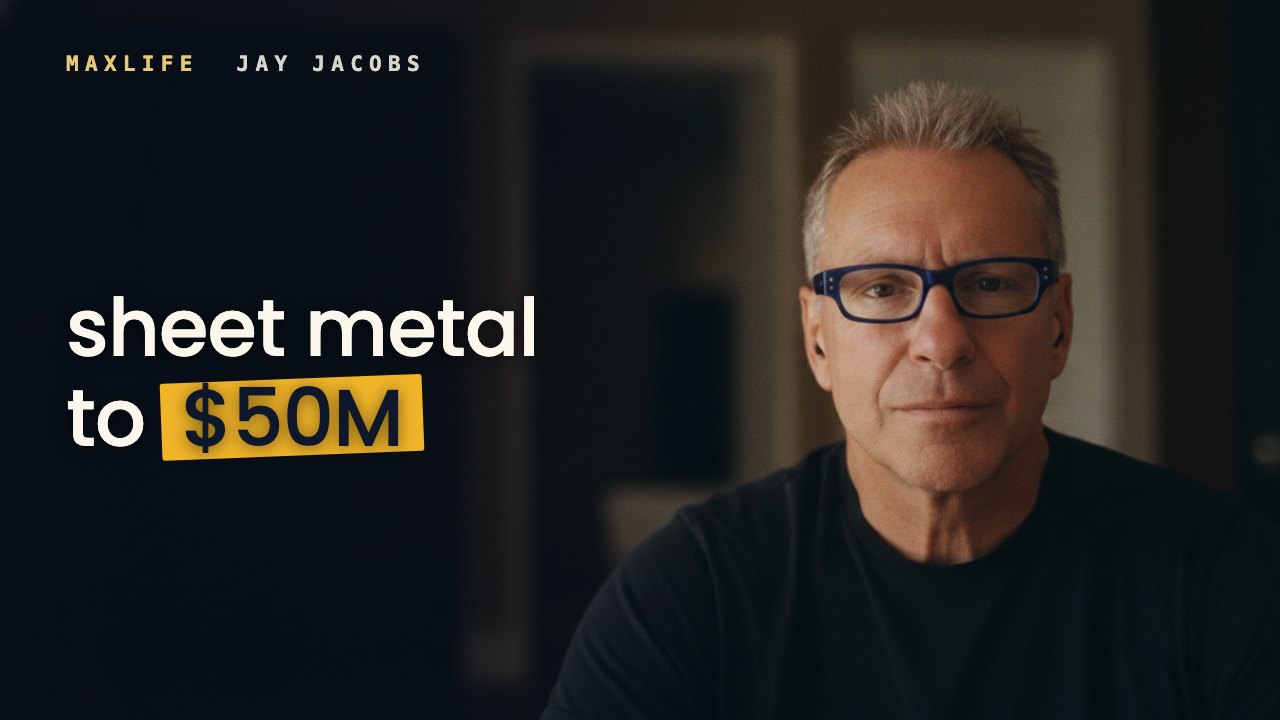
Jay Jacobs went from zero revenue and a shop set to close three days after 9/11 to a nine-figure exit, and says the hardest part had nothing to do with business. This is the conversation about agency, surrender, and what you actually owe yourself after you win.

With Jay Jacobs1h 20mEntrepreneurship · Agency · Mindset
The short version

Jay Jacobs built Rapid Sheet Metal from a $500K startup to nearly $50M in revenue and 300-plus team members before selling to the largest prototype machining company in the country. The financial exit is only half the story. Jay argues that most entrepreneurs are running someone else's script, chasing vanity metrics, and skipping the self-reflection that would actually set them free. The real breakthroughs came when he stopped limiting the business, started treating people as teammates rather than employees, and learned to close doors on his own terms before new ones could open. After the exit, plant medicine, the book Die with Zero, and a deeper study of agency reshaped how he spends his time, money, and attention, and he says the seasons of life framework is the thing he wishes he'd had in his twenties.

Key moments
What you'll take away

9 ideas from this conversation

01

Remove the limiter on the vision

Jay set a $5M ceiling before he'd even started. Reading The Magic of Thinking Big made him drop it entirely, and the business found its own level.

02

Teammates, not employees

Calling people team members wasn't semantics. It was a signal that their role mattered to a shared goal, and Rapid became the best company many of them ever worked for.

03

Scripts are just default mode

Family pressure, social hierarchy, and other people's success stories create a path of least resistance. Getting off it takes deliberate self-reflection, not just ambition.

04

Surrender is not giving up

Jay defines surrender as accepting who you actually are and building your life around it, which often takes more courage than following the script.

05

Close doors yourself before life closes them

The most impactful doors are the ones you choose to close. You often can't even see the new ones until the old ones are shut.

06

High agency people happen to life

Jay's definition: the person you'd call from a dirt-floor jail cell in a third-world country. They solve problems without announcing them and keep moving.

07

Memories compound like returns

Bill Perkins' Die with Zero reframed experiences as an asset class. The earlier you collect them, the longer they compound, and you retire on them.

08

Seasons end without warning

Your kids will stop holding your hand. The team you built will scatter. Recognizing the season you're in is the only way to actually be present inside it.

09

Put in the reps, including the bad ones

Jay's first podcast episodes were rough enough that he wishes he could delete them. He left them up as a reminder that you have to be willing to embarrass yourself.

Full show notes

#20: From $0 to $50M: Jay Jacobs on Redefining Success, Agency, and the Power of Surrender

How Jay Jacobs scaled a manufacturing company from zero to $50M

Jay Jacobs started Rapid Sheet Metal with family-and-friends money and a shop set to close on September 14th, 2001. Three days before closing, the world changed. Advisors told him to walk away. He didn't. "I'd rather try and fail than not try at all," he told Ben, "because I knew it would just eat me up inside if I didn't move forward." The first two years were brutal, a manufacturing recession, months where revenue barely cleared break-even, and a general manager he had to let go mid-flight. By 2017, Rapid had grown to over 300 team members and nearly $50M in revenue, leading its niche in prototype sheet metal and ranking second in prototype machining. The company sold to the largest prototype machining firm in the country, a publicly traded acquirer, in a nine-figure deal.

The mindset shift that removed the revenue ceiling

Early on, Jay had a number in his head: $5M in sales and he'd have made it. Then he picked up The Magic of Thinking Big on audio. "I was constraining myself," he said. "Don't put any limiters on there. What could this be?" From that point he set profitability metrics and let the business run. It found demand he hadn't anticipated and grew well past anything he'd originally imagined. The lesson he draws isn't about hustle, it's about the quiet ceilings entrepreneurs install before they've even started.

Why calling people teammates changed everything

Jay consciously used the phrase "team members" rather than employees from the beginning. His reasoning was simple: people spend more waking hours with their coworkers than with their families, so if they're not enjoying that time, something is wrong. Rapid built over a hundred distinct ways to celebrate as a team, monthly all-hands meetings on the shop floor, birthday and anniversary recognition, Friday grills in summer, bulletin boards tracking customer wins. "It was embedded in our culture, the celebration, that enjoying of the journey." When the company was sold and those metrics were compiled for the buyer, even Jay was surprised by the number.

Reframing leadership around agency, not control

Jay's clearest framework for talent is agency. His working definition: "Someone who has agency, they happen to life, whereas someone who doesn't have agency, life happens to them." The test he borrowed from another podcast: if you woke up in a dirt-floor jail cell in a third-world country with one phone call, who would you dial? That person is your highest-agency contact. Jay built Rapid and later Paperless Parts by finding those people, aligning their incentives with actual business outcomes, and then getting out of their way. His Paperless Parts co-founder Jason Ray, who was 30 at the time, is the clearest example, "he managed me," Jay said, not the other way around.

The power of surrender and closing doors on your own terms

When Ben asked what the opposite of following a script looks like, Jay's answer was immediate: surrender. Not giving up, surrendering to who you actually are. "Once you surrender and you recognize that this is who you are, and then you try to create your life around it... at the end of the day you can sleep better and you have more of a sense of purpose." He applies the same logic to transitions. Selling Rapid opened doors that would have stayed shut had he kept operating. He walked away from the deal once when the buyer tried to shut him out of Paperless Parts, a nine-figure deal, because his impact filter said that wasn't acceptable. The courage to close doors, he argues, is a muscle you build deliberately.

Die with Zero and the seasons of life framework

The book that shifted Jay's post-exit life was Bill Perkins' Die with Zero. Two ideas hit hardest. First: memories compound like financial returns, so the earlier you collect experiences, the longer they pay dividends. Second: life runs in seasons, and some of them end without announcing themselves. "There may be ones that you don't know when they're going to end. So you might as well grab the bull by the horns and get on it now." Since the exit, Jay has spent a month living in Buenos Aires, celebrated his 60th birthday in a treehouse 110 feet up in the Peruvian jungle canopy, and is chasing a sub-61-second 400-meter dash, one second per year of age. He's not retired. He's just playing a different game.


Quotable

Lines worth sitting with

I'd rather try and fail than not try at all, because I knew it would just eat me up inside if I didn't move forward.
Jay Jacobs
Someone who has agency, they happen to life, whereas someone who doesn't have agency, life happens to them.
Jay Jacobs
You have to close some doors before you can open others. And the doors that are most impactful are the ones that you have to close yourself and you have to have the courage to do so.
Jay Jacobs
You retire on your memories and they're like a financial return in that they compound.
Jay Jacobs
Free · No. 20 of the series

I know what success looks like on paper, but I'm not sure it's actually mine
Reflection Worksheet

The episode is 1h 20m. This worksheet is fifteen minutes. The fifteen minutes is the part that changes anything: five questions from this exact conversation, pointed at your business and your life. Answer them on paper while the ideas are still fresh, and they become yours for good.

  • The Door You've Outgrown
  • Whose Plan Is It
  • The Window Running Out
  • What Opens If You Close It
  • Close One Door This Week
You get this worksheet plus the full 75-worksheet binder, free.
5 prompts, 1 pagePrintable, binder-readyFree, no spam
Open the full worksheet →
Clips · grab & share

Short highlights from the episode

Short clips from this episode are on the way. Watch the full episode while we cut them.
The guest

Meet Jay Jacobs

Jay Jacobs on the MaxLife Podcast

Jay Jacobs

Founder, Rapid Sheet Metal · Co-founder, Paperless Parts · Entrepreneur and longevity athlete

Jay Jacobs founded Rapid Sheet Metal with family-and-friends money three days after 9/11 and scaled it to nearly $50M in revenue and 300-plus team members before a nine-figure exit in 2017. He co-founded Paperless Parts, now the leading quoting and estimating software for job-shop manufacturers, and spends his time investing in high-agency founders, competing in masters sprinting, and living out the Die with Zero philosophy he wishes he'd discovered decades earlier.

Questions, answered

Questions & answers

How did Jay Jacobs grow his company from zero to $50 million?
Jay started Rapid Sheet Metal in 2001 with family-and-friends funding, targeting a prototype sheet metal niche nobody else was serving. After two difficult years near break-even, demand accelerated and he removed internal revenue ceilings after reading The Magic of Thinking Big. By 2017 the company had over 300 team members and nearly $50M in revenue before a nine-figure sale.
What does high agency mean in business?
Jay defines high agency as happening to life rather than letting life happen to you. A high-agency person on your team doesn't bring you problems, they solve them and keep moving, often without telling you until later. The test he uses: who would you call from a dirt-floor jail cell with one phone call to get yourself out?
What is the Die with Zero philosophy and how does it apply to entrepreneurs?
Bill Perkins' Die with Zero argues that once your basic needs are covered, every additional dollar should be mapped to experiences rather than accumulated. For entrepreneurs, the key insight is that life runs in seasons, some predictable, some not, and delaying experiences until retirement means many of them simply won't happen. Jay applies this by front-loading adventures and staying conscious of which season he's currently in.
How do you build a strong team culture in a manufacturing company?
Jay built over a hundred distinct ways to celebrate at Rapid, from all-hands shop-floor meetings to customer-win bulletin boards to summer grills. The foundation was treating people as team members with a stake in a shared goal, not employees filling a role. He also committed to radical transparency, sharing the good, the bad, and the ugly every month, because silence creates rumor.
What are the biggest mistakes entrepreneurs make when scaling a business?
Jay names three: trying to be an entrepreneur as it's scripted rather than in your own skin, chasing vanity metrics and unicorn comparisons instead of defining what success actually looks like for your life, and failing to ask whether the hours and capital you're committing are aligned with your real priorities. He asks every entrepreneur he coaches: what does your life look like in five years, not just your revenue?
How do you develop more empathy as a leader?
Jay describes himself as a left-brain mechanical engineer who had to deliberately build the empathy muscle. The shift came through plant medicine retreats, which he says showed him how much of what he thought was important simply wasn't. Day to day, he practices by listening without preparing his response while the other person is still talking, and by trying to understand where someone is before deciding how to respond.
Share kit

Help spread this episode

Ready-to-post copy for guests and fans. Grab a caption, pick a clip above, and link this page.

Copy any of these word-for-word, or make them your own. They tag the show so it shows up when you post.

Social caption — long
Jay Jacobs built Rapid Sheet Metal from a $500K startup, launched three days after 9/11, to nearly $50M in revenue and a nine-figure exit. But the conversation he had with @MaxLifeBenLaws goes way beyond the numbers. Jay talks about removing self-imposed ceilings, building a culture with 100+ ways to celebrate, defining high agency (and the dirt-floor jail cell test), the power of surrender, and why the Die with Zero seasons-of-life framework changed how he spends every dollar and every day. If you're building something and you've ever felt capped, this one's worth your hour. Full episode + free worksheet at https://maxlifecoach.com/episodes/from-0-to-50m
Social caption — short / quote
From $0 to $50M, a nine-figure exit, and the mindset that made it possible. Jay Jacobs on agency, surrender, and Die with Zero with @MaxLifeBenLaws. https://maxlifecoach.com/episodes/from-0-to-50m
Email — share with your audience
Subject: Episode worth your time, Jay Jacobs on MaxLife

Hey,

Thought of you when I listened to this one. Jay Jacobs built a manufacturing company from nothing to nearly $50M in revenue, took a nine-figure exit, and then spent the next chapter figuring out what success actually means on his own terms.

He talks about removing the mental ceiling he put on his own business, why he called everyone on his team a teammate (and what happened as a result), his definition of high agency, and the Die with Zero framework that reshaped how he thinks about time, money, and seasons of life.

There's also a free reflection worksheet if you want to sit with the ideas.

Full episode here: https://maxlifecoach.com/episodes/from-0-to-50m

Think you'll get something out of it.
Copied