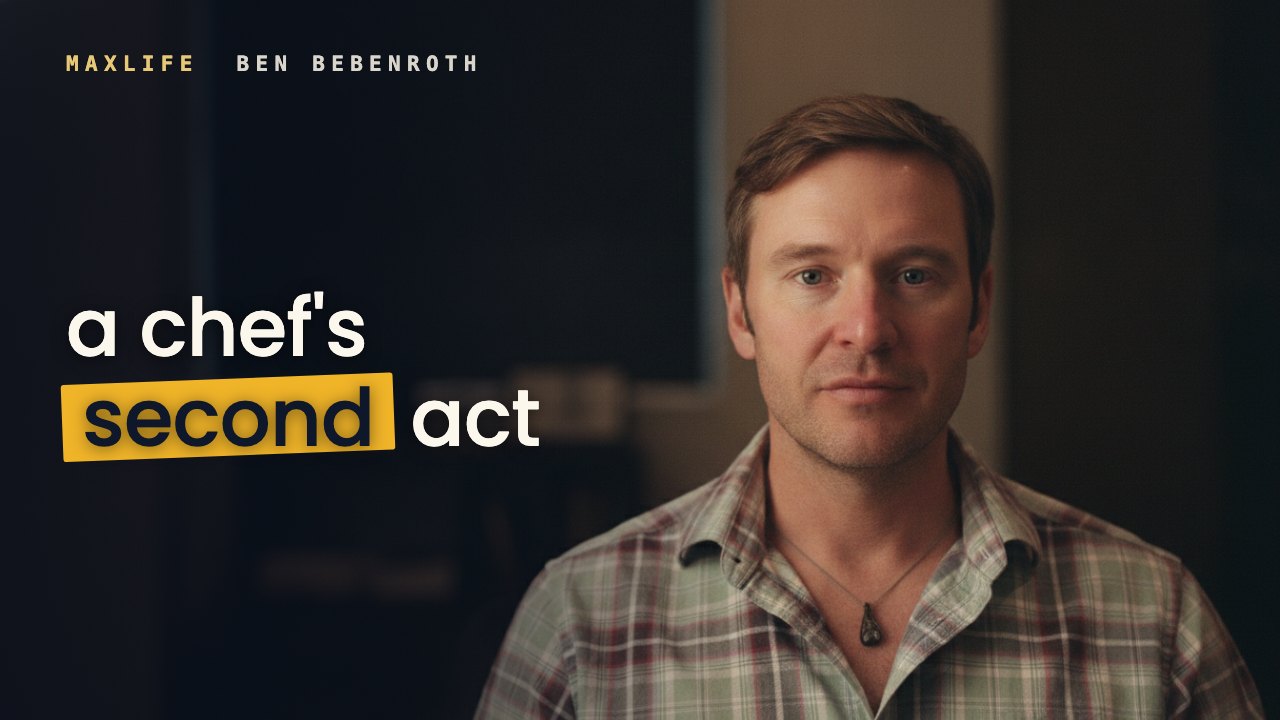
Burnout recovery after business collapse: what COVID actually forced Ben to face
When the pandemic hit, Ben Bebenroth didn't wait. He permanently closed his flagship fine dining restaurant on the first day of lockdown, the first in the continental United States to do so, laid off 39 employees, refunded $350,000 in deposits, and sent every team member home with food, masks, and two weeks of supplies. "No decisions will be made in a fear state," he told his team. "Anything we decide to do would be out of protection alone. And that ain't strategy. That's covering your ass."
What followed wasn't a pivot born of panic. It was a deliberate retreat, a sauna on the farm, a journal, and a question: What would Boom do? Boom was his grandfather, born in the Great Depression, a World War II radio operator on medevac planes who raised four kids in a thousand-square-foot home and died with a million dollars in stock no one knew about. That question became the foundation of Boom Pizza, a recession-proof concept named after a man who knew how to build something that lasts.
Ego-driven hustle and the proving phase of entrepreneurship
Ben's culinary career started the way a lot of them do, thrown on a cook line with no training, immediately in love with the intensity. "My intensity is finally welcome in this environment," he says of those early years. "From a kid that's been getting put in the freaking hallway his whole life, to then all of a sudden there was an environment that was so intense, we need you right now."
That intensity carried him through the Marine Corps, culinary school, a national cooking competition, and two and a half months cooking for dignitaries in Australia. It also carried him into eight years of running a fine dining restaurant that lost $100,000 a year. The external brand and the internal reality were completely different stories. "I had to drink away that inevitability of failure, just knowing there's no way out of this without shame."
His first mentor, Rick Doody, told him exactly what to do in 2014: wrong location, wrong concept, move it, reopen it, make a million dollars in two years. Ben walked away from the relationship. "I was not ready for that teacher to appear." The message waited six years for him to catch up to it.
How to find a mentor, and why you probably can't force it
Ben's take on mentorship cuts against the LinkedIn advice: stop seeking a mentor and start becoming someone worth mentoring. "The pursuit of a mentor is less important than the welcoming of a mentor." His own turning point came when Chef Ben Fambrow, without being asked, arranged a Johnson and Wales admissions rep to show up at the hotel where Ben was working, on the clock, with an advanced standing test. Ben took it in the lobby, nailed it, and graduated top 10 in his class.
"I would not have chosen it because I still had so much ego at play," he says. The question he'd ask anyone stuck in that proving phase: "How's that working out?" Not a statement. A question. Let the answer do the work.
Childhood trauma and the hidden operating system driving your decisions
The real excavation happened in April 2021, during a psychedelic journey that surfaced a memory Ben had carried, without fully knowing it, since he was 11 years old. He'd been chasing his brother with a steak knife during a game of Teenage Mutant Ninja Turtles. His brother missed the door handle, went through plate glass, cut every tendon in his thigh except one, and nearly bled out. The last words his brother said from the ground: "Get dad."
"I did that. That was a story I told myself, as opposed to: that happened." His father and brother became a unit through the recovery. Ben disappeared into his bedroom and was never asked if he was okay. He oriented toward other kids from broken homes, started skateboarding, got into heavy music, began injuring himself. "I was trying to show my parents that I too was in enough pain to be worthy of love."
His brother went on to thru-hike the Appalachian Trail, graduate from the Citadel, and become a Secret Service agent. "That moment defined me physically," his brother told him. "All of that came from that." The same event. Two completely different stories. Both true.
Sustainable success and values-centered leadership after the rebuild
Boom Pizza now sits inside the building his investors refused to let him sell. They handed him a $1.5 million check when the company had zero revenue. "We believe in you. You'll figure it out." He did. Pizza, 9.75% of all dining dollars spent outside the home in the US, gave him a scalable, process-based canvas for the ingredient obsession he'd spent decades developing. The farm still runs. The nonprofit still runs. The catering company never stopped.
What changed is the internal architecture. Ben now talks about showing up full, running a daily diagnostic on his own frequency, pulling levers when he catches himself in drill instructor mode, choosing his next moment deliberately. "It becomes about awareness, acceptance, and action. The space between awareness and acceptance is actually very large. But the space between acceptance and action is very, very quick."
He's not measuring success in index funds or golf games. He's measuring it in his integration with the earth, his family, and his ability to help people get out of their own way. "I don't really care how much money I make doing that."