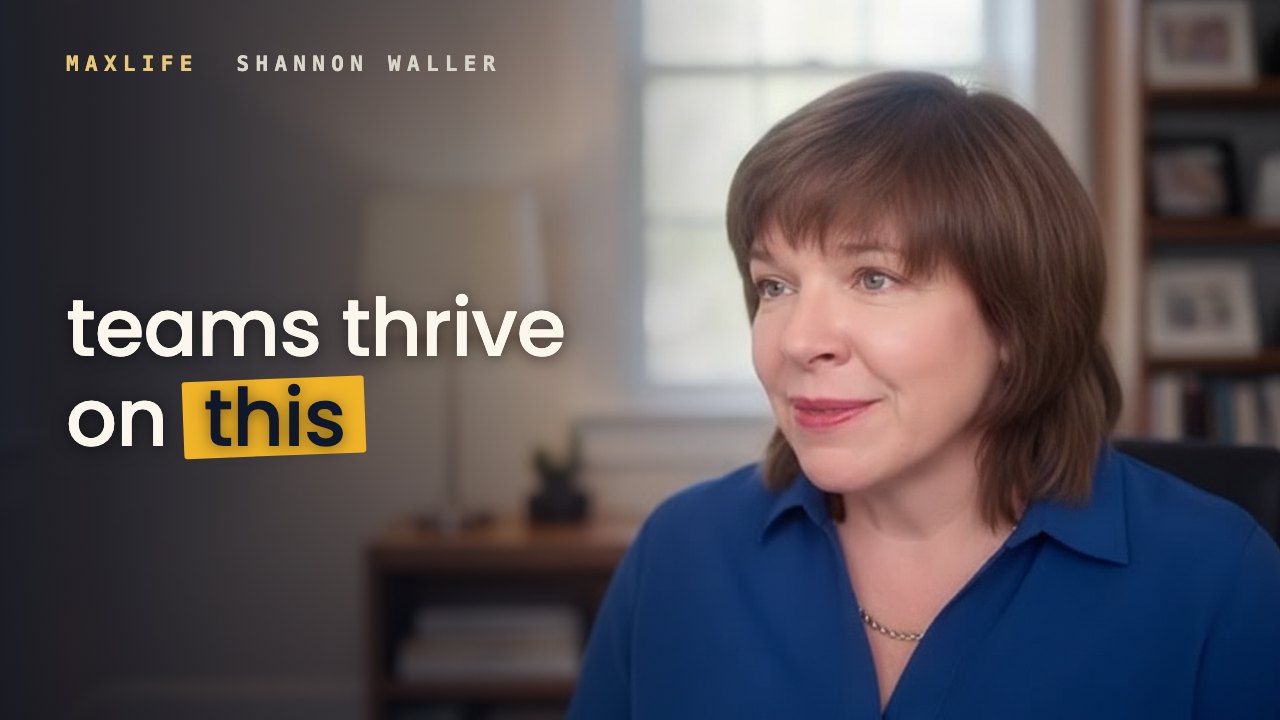
MaxLife Podcast · Episode

The Curiosity Quest: Creating Teams that Thrive with Shannon Waller

What if the secret to a thriving team isn't a better hiring process or a sharper org chart, but something far less obvious, curiosity, trust, and love? Shannon Waller has spent 30-plus years inside Strategic Coach proving exactly that.

With Shannon Waller1h 24mTeams · Leadership · Curiosity
The short version

Shannon Waller, Strategic Coach veteran and author of the Team Success Handbook, argues that the real ingredients of a high-performing entrepreneurial team are the ones most leaders skip: curiosity, trust, love, and genuine relationship. She explains that curiosity is a natural human state that gets covered up by exhaustion and fear, and that leaders who stay open to new ideas create the conditions for it to return. Her personal rule, 'I trust people to the degree that I think they know themselves', gives leaders a practical filter for who belongs on the team. And her Gap and Gain framework shows why anchoring people in their progress, not their shortfall against an ideal, is what actually fuels motivation and keeps teams moving forward.

Key moments
What you'll take away

9 ideas from this conversation

01

Curiosity gets covered, not lost

Shannon says curiosity is a natural human state that gets buried under exhaustion and fear. The leader's job is to clear the conditions that cover it up.

02

Trust starts with self-knowledge

Her personal rule: 'I trust people to the degree that I think they know themselves.' Someone who doesn't know themselves can't predict their own behavior, so neither can you.

03

Love is the motivation multiplier

Motivation comes from the heart, not the head. A person who loves what they do will outrun someone who's merely technically skilled every single time.

04

Relationship means being for someone

Being in relationship isn't a soft concept, it means 'I care about you, I want you to succeed, and I've got your back.' Without that, it's just a transaction.

05

Measure progress, not the gap

The Gap and the Gain: measuring yourself against an ideal always leaves you short. Turning around to see how far you've come is what builds confidence and momentum.

06

Openness is the framework for curiosity

If you shut down new ideas, your team stops bringing them. The culture of curiosity lives or dies with how the leader responds to the first few uncomfortable suggestions.

07

Know thyself is the entry requirement

Shannon won't invest deeply in working with people who aren't curious about how they operate. Profiles, reflection, and common language are how you build a team that can actually talk to each other.

08

Team investment is asymmetrical return

Ben calls it 'the number one asymmetrical return' he's ever had. People who feel seen, heard, and understood don't just stay, they bring their whole brain to work.

09

Wrong fit costs more than the exit

Multiplication by Subtraction exists because Shannon kept watching entrepreneurs give power to people who were building their own hierarchy, not the company's. Spotting the symptoms early is the whole game.

Full show notes

#8: The Curiosity Quest: Creating Teams that Thrive with Shannon Waller

Why entrepreneurial teams are the fastest path to personal growth

Shannon Waller has a degree with a title so long she admits it took three years just to get through it, a Bachelor of Arts in Administrative and Commercial Studies with a specialization in Social Organization and Human Relations. Translation: how do people work together? She's been answering that question ever since, and her answer keeps coming back to the same place. "The best place to learn and grow is a company, especially an entrepreneurial company." Unlike academia or corporate hierarchies, entrepreneurial companies give you immediate feedback. You find out on the 15th and 30th of every month whether what you did created value. That feedback loop, Shannon argues, is what makes entrepreneurial teamwork the fast track for both professional and personal development.

What real leadership looks like in a networked economy

The old model of leadership, I say, you do, worked on assembly lines. It doesn't work now. Shannon is direct about it: "If you cannot care deeply about the people with whom you work, you would not be welcome in my company." She and Dan Sullivan are co-authoring a book called Growing Great Leadership, and the core argument is that leadership in the networked economy requires genuine relationship skills. That means being invested in someone else's success, not just their output. Shannon has worked with Kathy and Jodet at Strategic Coach for 23 and 25 years respectively. "I love them," she says, without any hesitation. That's not a soft statement, it's a strategic one.

Curiosity as a survival mechanism for entrepreneurial companies

Shannon came back from Abundance 360, Peter Diamandis's exponential technology conference, the night before this conversation. She was struck by how the smartest people in the room were also the most intensely curious, about material science, AI, digital currencies, everything. Her take: curiosity and intelligence travel together. But she's also clear that curiosity isn't a personality trait reserved for a few, it's a natural human state that gets covered up. Exhaustion covers it. Fear covers it. Boredom covers it. The leader's job isn't to install curiosity in people; it's to stop suppressing it. And the framework for that is simpler than most expect: stay open to new ideas. If you shut down what your team brings, they stop bringing it.

Trust, love, and the non-obvious ingredients of high-performing teams

Ben asked Shannon for the non-obvious umami ingredients of a great team, the ones that are in the recipe but easy to miss. Her first two answers: love and trust. She traces the love piece back to motivation science. Kolbe's framework breaks the mind into three parts: cognitive (IQ), affective (motivation, preference, heart), and conative (instinct, will, action). "Everything starts with motivation. You are not motivated to learn something if you don't care about it." Motivation lives in the heart. That's where love comes from. Combine someone who's technically skilled with someone who's technically skilled and loves what they do, and the second person wins every time. On trust, Shannon shares her personal rule: "I trust people to the degree that I think they know themselves." She tests for this by asking questions and watching whether people reflect on their experience, whether they seem curious rather than judgmental, and whether they're willing to put language to their own uniqueness through profiles and self-assessment tools.

The Gap and the Gain: how to anchor your team in progress

One of the most practical frameworks in this conversation is the Gap and the Gain, which Shannon traces back to a moment she witnessed firsthand. Dan Sullivan was talking to a client who'd just had his best quarter ever, biggest client, biggest contract, and the client came in saying things were terrible. Dan drew a line on a flip chart. Here's where you are. Here's your ideal. The gap between them is permanent, like a horizon that moves as you run toward it. Measuring yourself against the ideal always leaves you short. But if you turn around and measure from where you started, you see your actual progress. That's the gain. Shannon used this framework the day before this episode recorded, coaching a team showing signs of burnout. She had them map their momentum, their motivation, their multiplier projects, then anchor in their Clifton Strengths. "One person said, 'I now know myself better.' That was her win." The result: shoulders dropped, energy returned, and people started talking about what they were capable of instead of what they were failing at.

Investing in your team as the highest-return leadership decision

Ben is direct about his own experience: "The number one asymmetrical return that I've ever had has been investing into my team, hands down." He flew his whole team to Toronto multiple times. He ran them through Working Genius, Kolbe, Clifton Strengths. He asked them how they'd improve processes, what their vision was, what they needed. Shannon's observation from the outside: the message that sends is enormous. People who feel seen, heard, and understood don't just stay, they bring their whole brain to work. And the ones who aren't the right fit often opt out on their own. You don't have to do the heavy lifting. The investment itself does the sorting.


Quotable

Lines worth sitting with

The best place to learn and grow is a company, especially an entrepreneurial company.
Shannon Waller
My personal rule is: I trust people to the degree that I think they know themselves.
Shannon Waller
The number one asymmetrical return that I've ever had has been investing into my team.
Ben Laws
Are you happy with what you're doing? And out of my mouth pops, 'No, I'm bored.' Weeks after that, I was on board with Strategic Coach.
Shannon Waller
Free · No. 8 of the series

I want a team that actually wants to be there
Reflection Worksheet

The episode is 1h 24m. This worksheet is fifteen minutes. The fifteen minutes is the part that changes anything: five questions from this exact conversation, pointed at your business and your life. Answer them on paper while the ideas are still fresh, and they become yours for good.

  • How Well You Know You
  • Where Curiosity Went Quiet
  • Curious, Not Judging
  • Skilled Versus Lit Up
  • Show One Person You're For Them
You get this worksheet plus the full 75-worksheet binder, free.
5 prompts, 1 pagePrintable, binder-readyFree, no spam
Open the full worksheet →
Clips · grab & share

Short highlights from the episode

Short clips from this episode are on the way. Watch the full episode while we cut them.
The guest

Meet Shannon Waller

Shannon Waller on the MaxLife Podcast

Shannon Waller

Team Strategist, Author & Strategic Coach® Program Creator

Shannon Waller joined Strategic Coach in 1991 and has spent more than three decades helping entrepreneurs build teams that run on unique ability, not just job descriptions. She created the Entrepreneurial Team Program and has authored multiple books including the Team Success Handbook and Multiplication by Subtraction. She's a certified Kolbe consultant of 30 years and one of the clearest thinkers alive on what it actually means to work in relationship.

Questions, answered

Questions & answers

How do you build a curious team culture?
Shannon's answer is that curiosity is already there, it gets covered up by exhaustion, fear, and leaders who shut down new ideas. The framework is openness: if you respond to your team's ideas with genuine interest instead of dismissal, curiosity comes back on its own. Profiles and shared language help too, because people can't be curious about each other if they have no vocabulary for their differences.
What is the Gap and the Gain in team leadership?
The Gap is the permanent distance between where you are and your ideal, measuring against it always leaves you feeling short. The Gain is what you see when you turn around and measure from where you started. Shannon uses this framework to pull teams out of burnout by anchoring them in real progress before asking them to push forward again.
What makes entrepreneurial teams different from corporate teams?
Shannon argues that entrepreneurial companies have fewer mediations between you and the world. You find out fast whether you created value. That immediate feedback loop accelerates both professional and personal growth in ways that large corporate environments, with their layers and politics, simply can't match.
How do you know who to trust on your team?
Shannon's personal rule is to trust people to the degree she thinks they know themselves. She tests for self-knowledge by asking reflective questions, watching whether someone is curious rather than judgmental, and seeing whether they're willing to engage with profiles and self-assessment tools. Someone who doesn't know themselves can't predict their own behavior, and neither can you.
Why is investing in team development worth it for entrepreneurs?
Ben describes it as the highest asymmetrical return he's ever had across any investment. When people feel seen, heard, and understood, and when the leader backs that up with real money and time, not just words, they bring their whole brain to work. Shannon adds that the investment also does its own sorting: people who aren't the right fit often opt out without being pushed.
What is Multiplication by Subtraction in team building?
It's the title of Shannon's second book, and the concept is about recognizing when someone on your team is there for their own agenda rather than the company's. She wrote it after watching entrepreneurs repeatedly give power to people who were building their own internal hierarchy. The book includes a symptom checklist, check off more than three or four for one person and you have a red flag worth acting on.
Share kit

Help spread this episode

Ready-to-post copy for guests and fans. Grab a caption, pick a clip above, and link this page.

Copy any of these word-for-word, or make them your own. They tag the show so it shows up when you post.

Social caption — long
What actually makes a team thrive? Not a better org chart. Not a sharper hiring process. According to Shannon Waller, Strategic Coach veteran of 30+ years, author of the Team Success Handbook, and one of the clearest thinkers alive on entrepreneurial teamwork, the real ingredients are curiosity, trust, and love. In episode 8 of the Max Life Podcast, Shannon and Ben Laws go deep on what it means to lead through relationship, why the Gap and the Gain changes everything for burned-out teams, and why investing in your people is the highest asymmetrical return an entrepreneur can make. "The best place to learn and grow is a company, especially an entrepreneurial company." Full episode, show notes, and free reflection worksheet at https://maxlifecoach.com/episodes/the-curiosity-quest. @MaxLifeBenLaws
Social caption — short / quote
"I trust people to the degree that I think they know themselves." Shannon Waller on curiosity, trust, and building teams that actually want to be there. Episode 8 of the Max Life Podcast is live. https://maxlifecoach.com/episodes/the-curiosity-quest @MaxLifeBenLaws
Email — share with your audience
Subject: Episode 8, Shannon Waller on Teams that Thrive

Hey,

Thought you'd want to hear this one. Ben Laws sat down with Shannon Waller, Strategic Coach veteran since 1991, author of the Team Success Handbook, for a conversation about what actually makes entrepreneurial teams work.

They cover curiosity as a survival mechanism, why love and trust are the non-obvious ingredients most leaders skip, and a framework called the Gap and the Gain that Shannon used the day before this episode to pull a burned-out team back to life.

Ben's take: investing in his team has been the single highest asymmetrical return he's ever made. Shannon shows you exactly how to do it.

Full episode, show notes, and a free reflection worksheet here: https://maxlifecoach.com/episodes/the-curiosity-quest

Worth your hour.
Copied