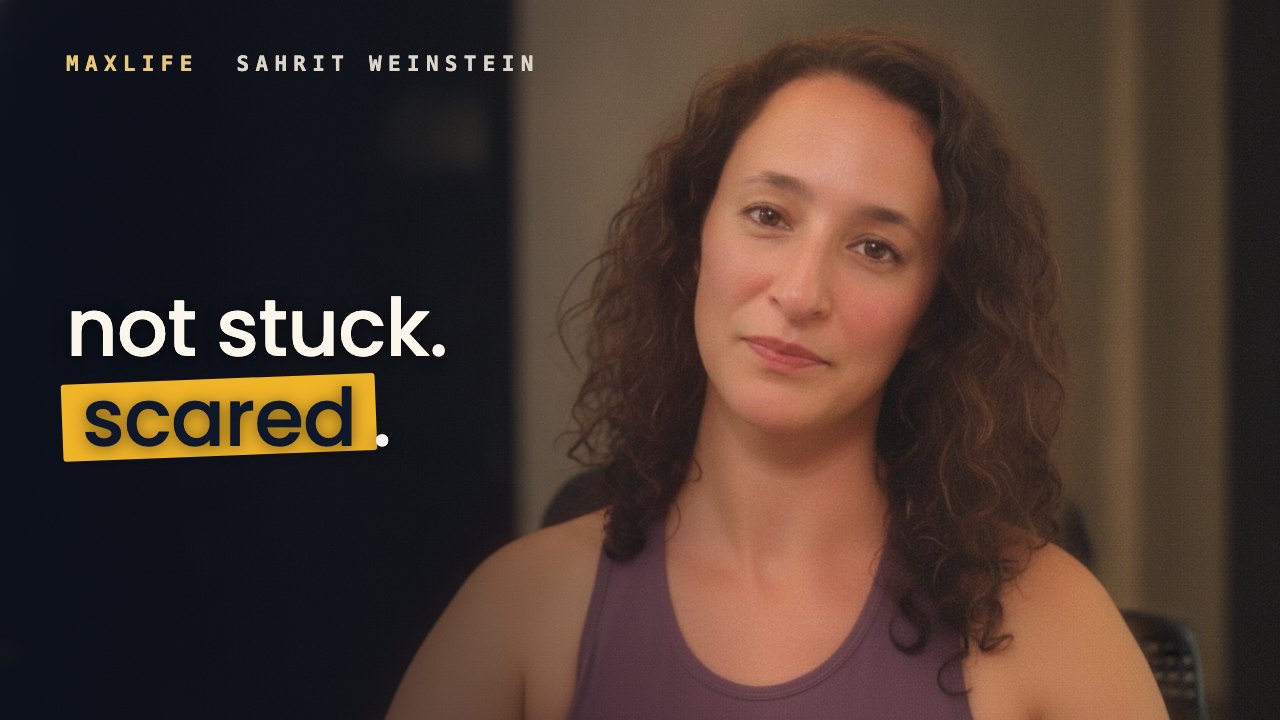
We tend to picture fear as something loud: a phobia, a panic attack, a white-knuckle moment. But the fear that shapes most lives is quiet. It shows up as a preference for the familiar, a story that "this is just who I am," and a thousand small nos we never question. In this episode of MaxLife, Ben Laws sits down with author and speaker Sahrit Weinstein to talk about the fear hiding inside comfort, and why the thing you keep avoiding is usually the door.
Worry bunnies vs. wonder bunnies
Sahrit's book, The Girl Who Doesn't Go on Roller Coasters, is about turning "worry bunnies into wonder bunnies." A worry bunny catastrophizes. They see the cup on the edge of the table and the disaster that follows. She knows the type because she is one: "negative thoughts find me a lot more than most people." The shift isn't pretending the worry isn't there. It's learning to meet the worst-case story with curiosity instead of belief.
Your thoughts are not you (handling negative self-talk)
The turning point came when she realized something simple and freeing: "Our thoughts are not ours. Just because we have negative thoughts doesn't mean we're a negative person." Changing your negative self-talk isn't about winning an argument with your mind. It's about no longer taking every thought as a fact about who you are. You can have the thought and still choose the action.
Where the worry begins
Sahrit traces her anxiety to age 11: panic attacks, hyperventilating in the school bathroom, a father with untreated anxiety she watched melt down on a flight during turbulence. She inherited the fear and the stress, then spent years blaming her parents for it, until the work turned blame into compassion. If you've ever wondered why you worry so much, the answer is often older than you think, and it isn't a character flaw. It's an inherited pattern you can re-pattern.
Why we stay in the comfort zone
Fear's favorite disguise is comfort. Ben connects it to building companies: the moment a team gets comfortable is usually the moment the edge dulls. Stepping out of your comfort zone isn't about chasing adrenaline. It's about noticing where you've gone numb. Sahrit puts it bluntly: in any partnership, notice who loves the comfort zone and who's the adventurer, then ask honestly which one you've been playing.
Fear of flying, panic attacks, and the body's alarm
The episode doesn't pretend fear is just mindset. Sahrit's fear of flying and panic attacks were physical, the body's alarm system stuck in the on position. What changed wasn't that the fear vanished. It was that she stopped letting the alarm make the decisions. She went "kicking, yelling, and screaming" into the adventures anyway, and discovered the alarm was almost always wrong about what she couldn't survive.
Courage comes from within
For years Sahrit thought her husband was the source of her courage. The deeper truth: "It wasn't anyone else who brought me courage. It has to come from within." Every time she conquered a fear, she got a new self in return: "Oh my gosh, I didn't know I could do that. And if I can do that, what else can I do?" That's the loop the episode is really about. Fear, walked through, doesn't just shrink. It hands you evidence of who you're becoming.
Living on the extremes
If you feel anxiety deeply, you likely feel joy just as deeply. Sahrit lives "on the extremes," and the reframe that stuck was: your sadness runs extreme, but so does your happiness, and you're mostly on the happy side, so it's worth it. For sensitive, high-feeling people, the depth isn't the problem. Un-metabolized fear is. Ben calls it "misaligned metabolization," energy that has to go somewhere.
How to face the fear you've been avoiding
The practice that runs through the whole conversation: name the quiet fear, treat it as information, take the smallest real step, and let the rebirth on the other side become the proof. You don't have to feel ready. As Sahrit says at the close, "I don't know what I'm doing, and that's okay. We all have fears, and as long as we're willing to keep going, that's what matters."