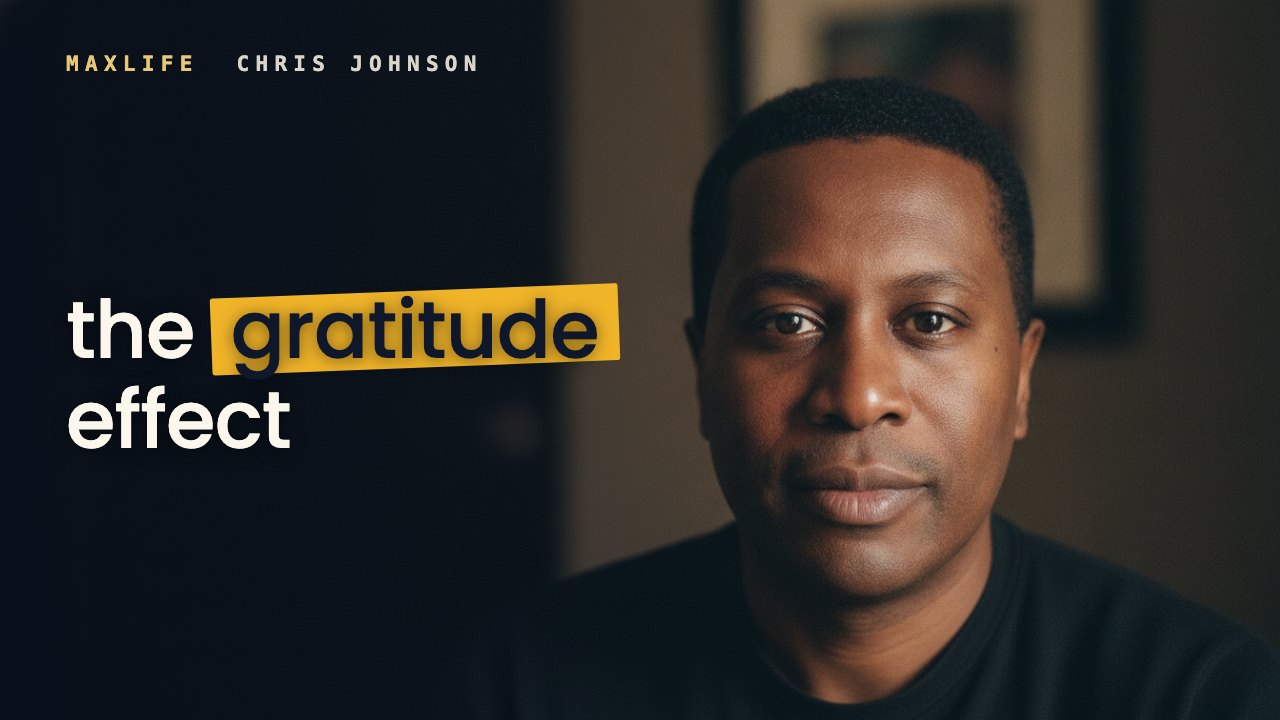
The gratitude mindset that changed everything for Chris Johnson
There is a version of this story that starts on a stage, Shark Tank, a multi-million dollar consumer products company, a nine-figure tech exit in progress. But the real story starts on a carpet. Chris Johnson, CEO of Rapid Brands and founder of Passive Candidate ProAI, was locked in his office, trying to make payroll, and losing. "I was laying on the carpet in my office, the door was locked, and there were tears in my eyes, man." What pulled him off the floor was not a strategy. It was a question from a sermon: what do you have left? He still had a wife who adored him. He still had healthy kids. He had a life a million men would stand in line to live for one day. That inventory became the foundation of everything that followed.
How to win the day before it starts: Chris's morning routine for entrepreneurs
Chris is explicit that gratitude is not passive. It is a daily practice he calls "seek him first," and he runs it on a treadmill before he opens a single email. The routine has four parts: a blessing list of specific things he is grateful for right now, an adversity inventory where he looks back at hard seasons and finds the blessings that came from them, an expectation list of good things he is genuinely excited about, and a prayer of thanks. "My mindset is so high that when the affliction comes, it's too high for the sight and the afflictions to touch it." He is clear about what happens when he skips it: "I'm easily moved. I'm irritable. I'm weary. And you can't show up the best for your family and for your team." The morning routine is not self-help theater. It is competitive preparation.
Overcoming adversity: why entrepreneurs suffer twice and how to stop
One of the sharpest insights in this conversation is what Chris calls suffering twice. You suffer now, feeling the full weight of a bad outcome that has not happened yet. And then if the outcome does go badly, you suffer again. "So you suffer then. And then because you had the doubt, you suffer when it doesn't happen." The antidote is not optimism. It is intentional fortification. When your mindset is already high before the day's problems arrive, a bad email from your CFO or a resignation letter does not have the same gravitational pull. You can dismiss the sight because you already have altitude.
Entrepreneurial success and the difference between knowledge and wisdom
Chris built his first business at 16, charging $5 at his own birthday party after the garage filled up, then creating Sacramento's first teen dance club circuit, then a modeling agency at 19 that placed extras in Training Day. By 25 he was the number-one producer out of more than 3,000 employees at one of the world's largest recruiting firms, making just under $200,000 a year on a $32,000 base. His wife Shauna, who has been with him since he was 14, gave him the line that sent him out the door to start his own company: "Chris, since we were kids, you always told me you wanted to be a millionaire, not a 200,000-aire." Through all of it, Chris draws a hard line between knowledge and wisdom. Knowledge is information in your mind. Wisdom is that information in your life. Most people, he says, stop at knowledge, they read the book, feel good, and put it back on the shelf.
Energy management for entrepreneurs: health, discipline, and the 36-pound shift
For most of his entrepreneurial career, Chris put his health last. The business always had a more urgent claim on his time. Then he found Superhuman, what he calls "the Strategic Coach of fitness", and built a system: 600 calories of deficit, 12,000 steps, 150 grams of protein, two to three workouts stacked into his morning. He is down 36 pounds and eight pounds away from his lightest weight in 20 years. But the more interesting shift is what it transferred to: "I think that has a transfer in some of the other things that I do as far as that discipline." Winning something physical that had eluded him for a decade changed how he approached other areas where he had been stuck.
Building wealth by investing in yourself first
Chris has tried real estate, squatters moved into one of his properties while a good tenant relocated, and he sold everything. He has given money to a trader and lost his shirt. What has never produced a loss, he says, is investing in himself: Strategic Coach, YPO, EO, Harvard Business School OPM. "Those investments have paid dividends not just in business but in my life, they have made me happier." His current wealth-building thesis is simple: deploy capital into what you know. He knows how to build businesses. He knows product-market fit. He sells with a giving heart, which makes trust immediate. That is where he puts his money until the nine-figure exit creates enough liquidity to diversify.
The future Chris Johnson is building: coaching, purpose, and multiplying the gift
The nine-figure exit is the financial goal. But when Ben asks what the real 10x leap looks like, Chris does not talk about the company. He talks about coaching. "I feel like I have a fiduciary duty to be a blessing with all the things that I know." He wants to build a coaching company, help people get breakthroughs, and serve on purpose because it is his purpose. He frames it in the parable of the talents, he does not want to be the servant who buried the gift. He wants to multiply it and hear "good and faithful servant" at the end.