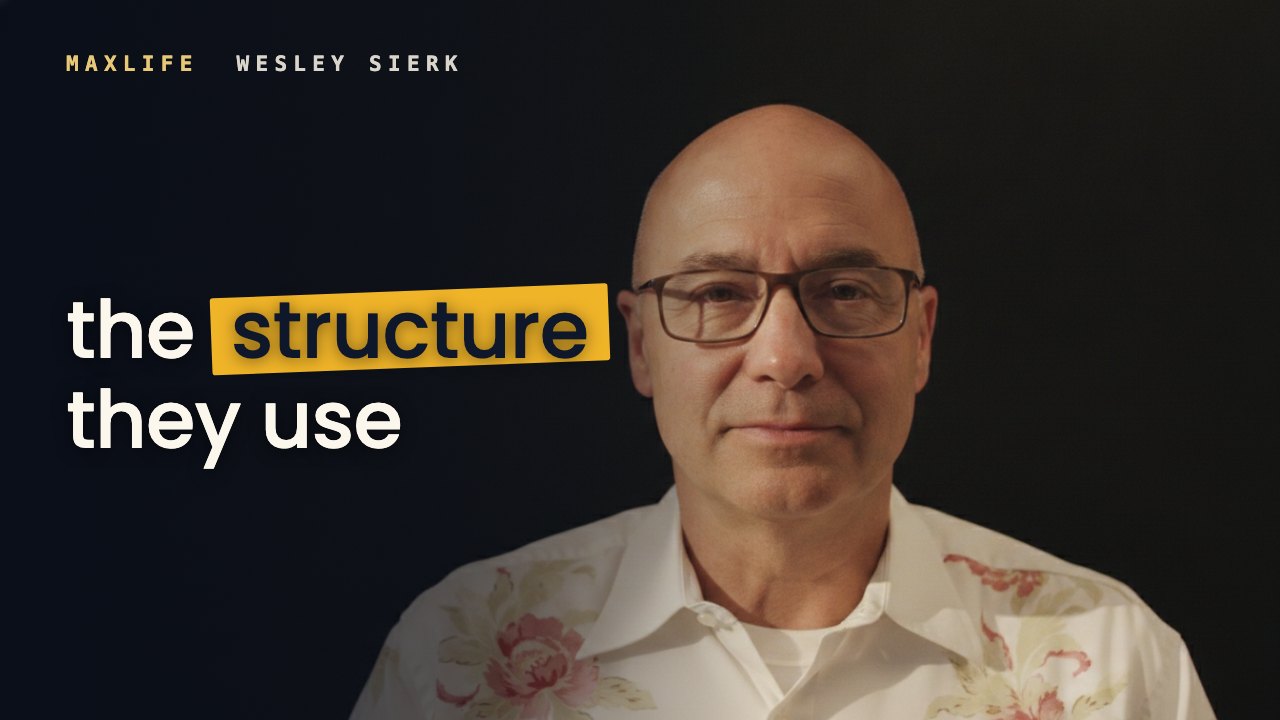
MaxLife Podcast · Episode

The Hidden Wealth Structure the Ultra-Rich Don’t Want You to Understand

The ultra-wealthy have been using a financial structure called captive insurance to protect profits, slash tax exposure, and turn business expenses into assets. Wesley Sierk spent decades building and selling these structures, and in this conversation he lays out exactly how it works.

With Wesley Sierk1h 56mCaptive Insurance · Wealth Strategy · Entrepreneurship
The short version

Captive insurance is a private insurance company owned by a business owner or group of business owners that insures the risks of their own operating businesses. Instead of paying premiums to a commercial carrier and watching that money disappear, the premiums flow into an entity you own, the underwriting profit stays with you, and the structure creates legitimate tax deductions at the operating company level. Wesley Sierk built and sold captive insurance businesses serving hundreds of companies and explains that most entrepreneurs are overpaying for commercial coverage while missing a legal, IRS-recognized structure the ultra-wealthy have used for decades. The strategy works best when a business has consistent, insurable risks and the owner wants to convert an expense line into a wealth-building asset. It is not a loophole or a scheme, it is the same infrastructure Fortune 500 companies have used for over 50 years, now accessible to smaller operators.

Key moments
What you'll take away

9 ideas from this conversation

01

Expenses can become assets

Captive insurance converts premium dollars that would vanish into a commercial carrier into capital that stays inside an entity you own. The expense line becomes a wealth-building vehicle.

02

The ultra-wealthy play a different game

Fortune 500 companies have used captive insurance structures for over 50 years. Most small business owners have never heard of it because nobody selling them commercial insurance has an incentive to tell them.

03

Email is someone else's agenda

Wes sold a company and nearly died two months later. His takeaway: 'Email is somebody else's thought on how you should spend your time, not how you should spend your time.'

04

Meditation is a meta skill

At 856 consecutive days and 31,000 minutes, Wes describes meditation as a skill that 'once you learn it, makes everything else in your life better.' He wishes he had started at 20.

05

Your wealth tracks how many people you help

Wes told his son: 'Your wealth is directly dependent on how many people you help.' Gates, Jobs, and Bezos got rich because they helped tens of millions of people, not hundreds.

06

AI is the private jet for your mind

Wes describes AI as a tool that 'allows you to explore a lot of different areas, a lot of different thinking in a really short amount of time.' The people who master it will write their own ticket.

07

Work expands to the time you give it

Wes set a hard rule early: no work email from 6 p.m. Friday to 9 a.m. Monday. His clients respected it. The boundary protected his family and, he believes, his business.

08

Sleep is non-negotiable after a brain injury

Wes learned the hard way that screens block brain healing and that sleep is when the brain repairs itself. He now treats sleep as a performance input, not a luxury.

09

Partners are the black velvet under the diamond

Wes credits his long-term business partners for keeping him focused: 'Their strength is my weakness and my strength is their weakness.' Aligned values make disagreements survivable.

Full show notes

The Hidden Wealth Structure the Ultra-Rich Don’t Want You to Understand

What is captive insurance and why do the ultra-wealthy use it?

Most business owners have never heard of captive insurance. That is not an accident. The commercial insurance industry has little incentive to explain a structure that routes premium dollars away from carriers and into an entity the business owner controls. Wesley Sierk spent decades building, operating, and eventually selling a national captive insurance practice, and his core message is blunt: the ultra-wealthy have been using this structure for over 50 years while most entrepreneurs keep overpaying for coverage they barely understand.

A captive insurance company is a licensed insurance entity owned by the insured. Instead of paying premiums to a third-party carrier and watching that money leave forever, the premiums flow into your own captive. If claims are low, the underwriting profit stays with you. The structure is IRS-recognized, it is legal, and it is the same infrastructure Fortune 500 companies have used since the 1960s.

Captive insurance tax strategy: how the deduction works

The tax mechanics are one of the most misunderstood parts of the strategy. At the operating company level, premiums paid to a captive are treated as a business expense, creating a deduction. Inside the captive, those dollars accumulate and can be invested. Over time, a well-run captive builds a reserve that belongs to the owner, not to a commercial carrier. Wes is direct about the implication: "You can make it, but can you keep it?", the title of one of his books, is exactly the question captive insurance is designed to answer.

The structure is not a loophole. It requires real insurable risk, proper actuarial pricing, and regulatory compliance. But for business owners with consistent, quantifiable risk exposure, it converts an expense line into a long-term asset.

Captive insurance for small business: who it actually fits

The common assumption is that captive insurance is only for large corporations. Wes pushes back on that directly. Group captives, in particular, allow smaller businesses to pool together, share risk, and access the same structural advantages that a single large company would use on its own. The key variables are consistency of risk, premium volume, and the owner's willingness to treat the captive as a real business rather than a tax trick.

Wes built his practice serving roughly 800 to 900 companies, not Fortune 500 giants. His clients were operators who wanted to stop bleeding premium dollars and start building something they owned. The structure works when the business owner is willing to think like an insurer, not just an insured.

From a 10-foot fall to a new definition of wealth

Two months after selling his insurance business to Risk Strategies in July 2019, Wes climbed onto the roof of his Palm Desert home in 116-degree heat to fix his own air conditioner. He fell approximately 10 feet, fractured his mastoid bone, and went into a coma. His neurosurgeon told him that 50% of people who fall from their own height and hit their head die. Wes fell nearly twice that distance.

The recovery took months. Screens were banned. Sleep was medically enforced at 18 to 20 hours a day. Black mold discovered in the family home added months to the timeline. COVID arrived and, in his words, gave him the time he needed to actually heal. What came out the other side was a different framework for what wealth means: "At this point, it's not about money. It's got to be about something bigger and greater."

The meta skills that compound everything else

Wes is now at 856 consecutive days of meditation and over 31,000 minutes logged. He describes it as "a meta skill that once you learn it, makes everything else in your life better." The analogy he uses is a freeway: meditation does not stop the cars, it just lets you choose which one to follow. He wishes he had learned it at 20 instead of 50.

Sleep, lifelong learning, and the ability to communicate face to face round out his framework. His 81-year-old father is currently studying for a physics final so he can qualify for an advanced architecture course. Wes cites that as the clearest model he has for what the next 50 years could look like. His AI hedge fund, which has autonomously traded 32 commodities since February 2019 and averaged a 23% return at 4% volatility, is his clearest bet on where wealth creation is heading. "The industrial revolution made the first millionaires, the internet made the first billionaires, and I believe AI will make the first trillionaires."
Quotable

Lines worth sitting with

Email is somebody else's thought on how you should spend your time, not how you should spend your time.
Wesley Sierk
Meditation is a meta skill that once you learn it, it makes everything else in your life better.
Wesley Sierk
Your wealth is directly dependent on how many people you help.
Wesley Sierk
The industrial revolution made the first millionaires, the internet made the first billionaires, and I believe AI will make the first trillionaires.
Wesley Sierk
Free · No. 34 of the series

I've been building wealth on hard mode and I didn't know it
Reflection Worksheet

The episode is 1h 56m. This worksheet is fifteen minutes. The fifteen minutes is the part that changes anything: five questions from this exact conversation, pointed at your business and your life. Answer them on paper while the ideas are still fresh, and they become yours for good.

  • Money That Leaves Every Year
  • Who Keeps What's Left
  • Rent Versus Own
  • Expense Into Asset
  • One Thing To Own
You get this worksheet plus the full 75-worksheet binder, free.
5 prompts, 1 pagePrintable, binder-readyFree, no spam
Open the full worksheet →
Clips · grab & share

Short highlights from the episode

Short clips from this episode are on the way. Watch the full episode while we cut them.
The guest

Meet Wesley Sierk

Wesley Sierk on the MaxLife Podcast

Wesley Sierk

Insurance entrepreneur, film producer, AI hedge fund co-founder, and medical device innovator

Wesley Sierk built a national insurance practice, sold it to Risk Strategies in 2019, and has since expanded into film production, an AI-driven commodity hedge fund, and a spinal technology company that won the most innovative spinal technology award of 2024. He survived a 10-foot fall that fractured his mastoid bone and put him in a coma, an experience that fundamentally reshaped how he thinks about time, health, and impact. He is also the author of 'You Can Make It But Can You Keep It?' and 'Because I Love You, Richard: A Father's Lessons for a Prosperous Life.'

Questions, answered

Questions & answers

What is a captive insurance company?
A captive insurance company is a licensed insurance entity that a business owner creates to insure the risks of their own operating business. Instead of paying premiums to a commercial carrier, the premiums flow into the captive, which the owner controls. If claims are low, the underwriting profit stays inside the structure rather than going to a third-party insurer. The IRS has recognized captive insurance as a legitimate business structure for decades.
What is captive insurance for dummies?
Think of it this way: every year you pay an insurance premium and hope you never need it. If you do not file a claim, that money is gone. A captive insurance company lets you pay that premium into a company you own. If claims are low, the profit stays with you and compounds over time. It is the same structure Fortune 500 companies have used since the 1960s, and it is now accessible to smaller business owners through group captive arrangements.
What is captive insurance for small business?
Small business owners can access captive insurance primarily through group captives, where multiple businesses pool their risks together. This lowers the entry threshold that a single-owner captive would require. The business still gets the tax deduction on premiums at the operating level, and the group shares in the underwriting profit if claims stay low. The key requirement is that the business has real, consistent, insurable risk.
What is a captive insurance tax strategy?
At the operating company level, premiums paid to a captive are deductible as a business expense, which reduces taxable income. Inside the captive, those premium dollars accumulate and can be invested. Over time, the captive builds a reserve that belongs to the owner. The strategy converts what would have been a pure expense into a long-term asset, provided the captive is properly structured, actuarially priced, and compliant with IRS guidelines.
What is the difference between a captive insurance company and regular insurance?
With regular commercial insurance, you pay a premium to a carrier, the carrier keeps the underwriting profit if claims are low, and you have no ownership stake in the outcome. With a captive, you own the insurance company, so the underwriting profit stays with you. The trade-off is that you also bear more of the risk, which is why captives work best for businesses with predictable, manageable risk profiles rather than highly volatile exposure.
What is a captive insurance program and how do you start one?
A captive insurance program is the full structure that includes the captive entity, its domicile jurisdiction, the actuarial analysis of your risks, the premium pricing, and the ongoing compliance and claims management. Starting one typically involves working with a captive manager or specialist who can assess whether your business risk profile qualifies, choose the right domicile, and handle the regulatory requirements. Wesley Sierk built a national practice doing exactly this for hundreds of companies before selling it in 2019.
Share kit

Help spread this episode

Ready-to-post copy for guests and fans. Grab a caption, pick a clip above, and link this page.

Copy any of these word-for-word, or make them your own. They tag the show so it shows up when you post.

Social caption — long
Wesley Sierk built and sold a national captive insurance practice, survived a 10-foot fall that put him in a coma, and came out the other side with a completely different framework for wealth. In this episode of the MaxLife podcast with Ben Laws, Wes breaks down what captive insurance actually is, why the ultra-wealthy have used it for 50 years while most entrepreneurs have never heard of it, and how the same structure is now accessible to small business owners. He also gets into his AI hedge fund averaging 23% returns, the meditation habit he wishes he had started at 20, and why your wealth is directly tied to how many people you help. Full episode, show notes, and free reflection worksheet at https://maxlifecoach.com/episodes/the-hidden-wealth-structure-the-ultra-rich-dont-want. @MaxLifeBenLaws
Social caption — short / quote
The ultra-wealthy have been using captive insurance to protect profits and reduce taxes for 50 years. Most entrepreneurs have never heard of it. Wesley Sierk explains the whole structure on the MaxLife podcast. Listen and grab the free worksheet at https://maxlifecoach.com/episodes/the-hidden-wealth-structure-the-ultra-rich-dont-want. @MaxLifeBenLaws
Email — share with your audience
Subject: That captive insurance episode you should hear

Hey,

I just listened to Wesley Sierk on the MaxLife podcast and thought of you immediately. He breaks down captive insurance in plain language, explains why the ultra-wealthy have used it for decades, and walks through how smaller business owners can access the same structure. He also talks about surviving a 10-foot fall, building an AI hedge fund, and the meditation habit he wishes he had started 30 years earlier. It is one of those conversations that covers a lot of ground but stays grounded the whole way through.

Full episode and show notes here: https://maxlifecoach.com/episodes/the-hidden-wealth-structure-the-ultra-rich-dont-want

Thought it was worth passing along.
Copied