MaxLife Podcast · Episode

The Silent Tipping Point: Why 2028 Changes Everything - Part 2 with Don Barden, Ph.D.

Behavioral economist Dr. Don Barden spent four years interviewing thousands of female leaders worldwide and came back with math that changes everything. The tipping point isn't coming. It's already running toward us.

With Don Barden1h 10mLeadership · Economics · Women
The short version

Dr. Don Barden's quantitative research shows women-led businesses outproduce male-led equivalents 3-to-1 in revenue and profit, retain employees twice as long, and grow production in years four through six. The math points to 2028 as the tipping point when women will hold the majority of global leadership positions, trending toward 72% by 2030-2032. The secret isn't gender, it's a three-step framework: show sympathy to the problem, show empathy to the person, then ask 'what would you do?' That sequence makes people feel seen, heard, and understood, which makes them valued and empowered. When 94% of employees already know how to fix the problems they bring you, the leader's job is to get out of the way and go innovate. Any leader, male or female, can run this playbook starting today.

Key moments
What you'll take away

9 ideas from this conversation

01

The tipping point is already running

Global leadership is already 42% female and accelerating. Don's math puts the majority crossover at 2028, tapping out near 72% by 2030-2032.

02

94% already know the fix

The person who brings you a problem knows how to solve it 94% of the time. Taking it from them doesn't show leadership, it kills empowerment and tanks retention.

03

Sympathy to the problem, empathy to the person

Female leaders separate the problem from the person, acknowledge both distinctly, and only then ask 'what would you do?' That sequence changes everything downstream.

04

Seen, heard, understood equals 3x

When a workforce genuinely feels seen, heard, and understood, they stay twice as long, produce more each year, and leave with gratitude instead of resentment.

05

It's not a girl thing

"It's not a girl thing. It's just something girls do." Any leader who runs the same framework gets the same results, the data doesn't care about gender.

06

Leaders should only do what only they can do

While her team solves the problems they already know how to solve, she's out innovating, growing, and leading. Getting in the weeds is a choice that costs 3x.

07

3x times 3x is not 6x

When female-led organizations that each produce 3x growth collaborate instead of compete, the result is 3x cubed, a compounding effect that dwarfs any merger-and-acquisition math.

08

Don't judge the past, you're its future

"You and I are the past of our future selves." Your great-grandchildren will call you a barbarian too. Give the past its context and focus on what you can do now.

09

The consumer wants the same thing the employee wants

Consumers of female-led organizations say they feel like the company "gets" them, the same language employees use. The leadership style reaches all the way to the buying decision.

Full show notes

The Silent Tipping Point: Why 2028 Changes Everything - Part 2 with Don Barden, Ph.D.

Why women are better leaders: what four years of data actually shows

Behavioral economist Dr. Don Barden didn't start with a hypothesis about gender. He started with a whiteboard, a lot of calculus, and a pattern he kept noticing in boardrooms around the world. "I started noticing the increase of women in decision-making positions," he says. "And I was playing with that one day and I looked at it and I said, there's got to be math on this thing."

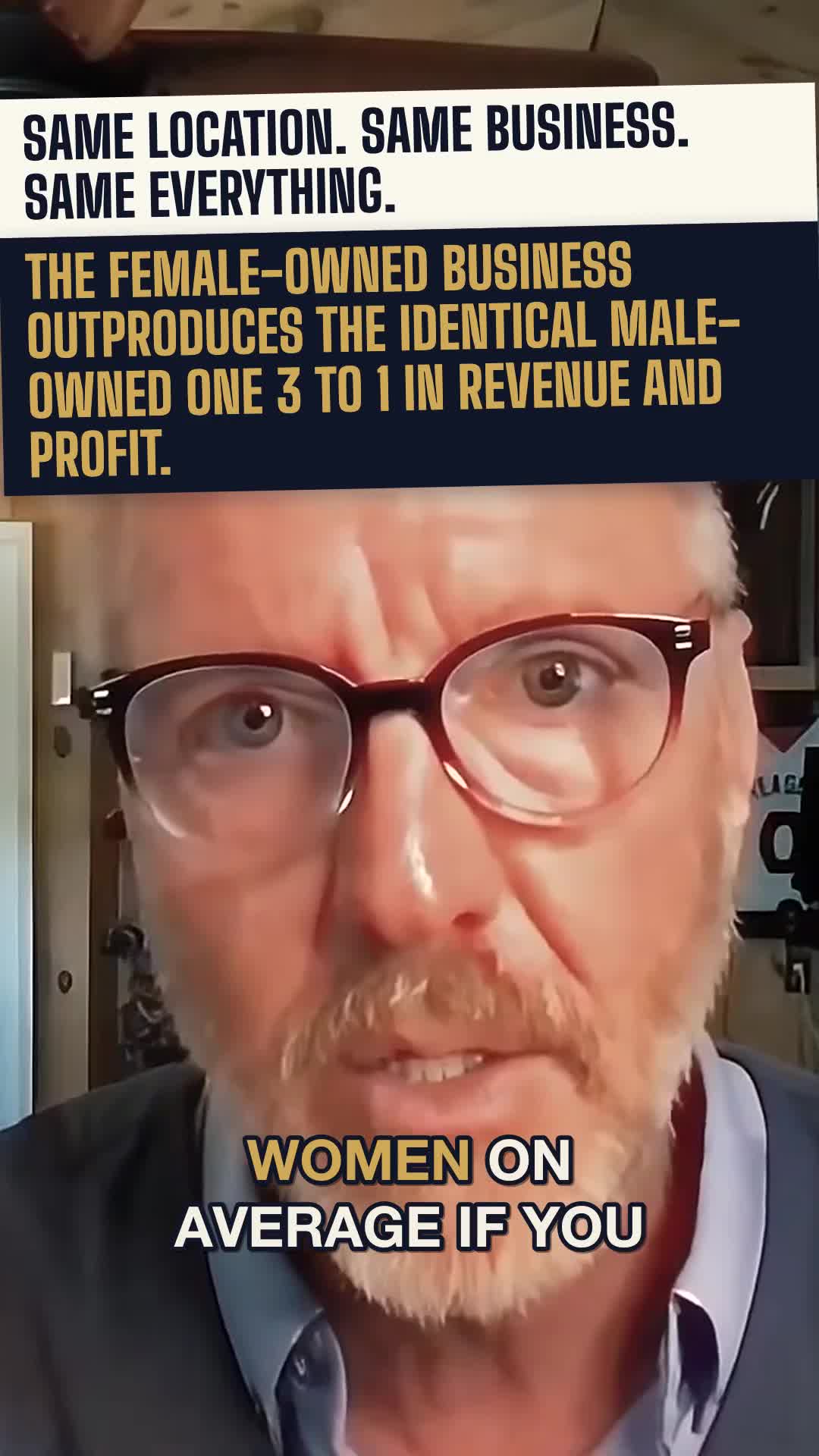
What the math showed was stark. Women-led businesses outproduce equivalent male-led businesses 3-to-1 in both revenue and profit. The average worker changes jobs every three years, unless they work for a female leader, in which case tenure doubles to six years. And in years four, five, and six, production keeps climbing. "She's figured out a way to double revenue, double profit, keep people twice as long, and increase their production, men and women, over the same amount of time," Barden says.

The 2028 tipping point: what the numbers say

Global leadership is already 42% female, and the curve is accelerating. Barden's quantitative modeling, built on decades of behavioral economic observation, puts the majority crossover at 2028, with the trend stabilizing near 72% female leadership by 2030-2032. Medical schools that were 30% female 25 years ago are now 68% female. Dental schools went from 3% to 70%. Six of the eight largest Wall Street firms controlling the majority of daily trades are already run by women.

"We are not slowly walking toward a tipping point. We are running toward a tipping point," Barden says. The rare thing about this research is that it satisfies both sides of the scientific ledger, quantifiable math and qualifiable phenomenon, which almost never happen together.

The 3-step leadership framework driving the growth

When Barden's team interviewed thousands of female leaders and asked how they did it, the pattern emerged by the second and third interview. Every leader told the same story. He calls it three steps that happen before any fixing begins.

Step one: sympathy to the problem. When someone brings a problem, she separates the problem from the person and acknowledges it as real. It's not that person's fault. It's just a problem.

Step two: empathy to the person. She looks back at that individual and says, in effect, "I know this isn't on you. We'll figure it out together." She doesn't collapse the two, sympathy goes to the problem, empathy goes to the human being standing in front of her.

Step three: the magic wand question. "Hey, if you had a magic wand, what would you do?" This is where the data gets uncomfortable for traditional leadership models. 94% of the people who bring you a problem already know how to fix it. The typical male leader, trained to fix things, takes the problem away from that person, neutering them, as Barden puts it, and loses both the solution speed and the employee's sense of ownership. She asks the question, hears the answer, and says: "Do it."

"What she's saying to that employee," Barden explains, "is: I see you. I hear you. And I understand you." A workforce that genuinely believes its leadership sees, hears, and understands them feels valued. Feeling valued plus being handed the authority to act equals empowerment. "You cannot stop that force," he says.

Why this is not a women-only leadership story

Barden is direct about this. The book is called Here Come the Girls, but the last line is: "It's not a girl thing. It's just something girls do." He points to Dr. Shaun Chopra, a head of cardiology at Harvard, who pulled up a chair beside patients, drew a Valentine's Day heart to explain bypass surgery, and made people feel like his only patient, while actually spending half the time with them that traditional doctors did. Chopra was running the same framework before anyone had named it. He was saying: I see you, I hear you, I understand you, and you're empowered to stop worrying.

"That proves it's not a girl thing," Barden says. "It's just something girls do naturally." Any leader who adopts the sympathy-empathy-magic-wand sequence gets the same results. The data doesn't filter by gender.

3x cubed: what collaboration does to the growth math

Here's where Barden's economic argument gets genuinely unusual. Female leaders, his research found, prefer collaboration over mergers and acquisitions. They want to work with other like-minded organizations. So when a 3x-producing organization collaborates with another 3x-producing organization, you can't add them. "It's not 6x," Barden says. "It's 3x cubed." The compounding effect of seen-heard-understood cultures working together is the economic expansion he's forecasting, bigger, he argues, than the agricultural, industrial, and dot-com revolutions combined.

"We're about to go into a global shift in our economy that's going to be so great. If we're half wrong, who cares?"

Quotable

Lines worth sitting with

We are not slowly walking toward a tipping point. We are running toward a tipping point.
Don Barden
It's not a girl thing. It's just something girls do. So if men start doing it, what is about to happen to our economy?
Don Barden
The people who bring you the problems, 94% of the time, know how to fix the problem. Think about that.
Don Barden
What she's saying to that employee is: I see you. I hear you. And I understand you.
Don Barden
Free · No. 48 of the series

I want to lead in a way that makes people feel seen, heard, and understood
Reflection Worksheet

The episode is 1h 10m. This worksheet is fifteen minutes. The fifteen minutes is the part that changes anything: five questions from this exact conversation, pointed at your business and your life. Answer them on paper while the ideas are still fresh, and they become yours for good.

  • Your First Reaction
  • Sympathy For The Problem
  • Empathy For The Person
  • Hand Back The Keys
  • The Conversation You Owe
You get this worksheet plus the full 75-worksheet binder, free.
5 prompts, 1 pagePrintable, binder-readyFree, no spam
Open the full worksheet →
Clips · grab & share

Short highlights from the episode

Short clips from this episode are on the way. Watch the full episode while we cut them.
The guest

Meet Don Barden

Don Barden on the MaxLife Podcast

Don Barden

Behavioral Economist, Strategist & Author · "Here Come the Girls"

Dr. Don Barden is a behavioral economist and leadership strategist who has taught at the Wharton School of Business and Oxford, and spent more than 20 years attached to the 75th Ranger Regiment. He has advised organizations ranging from NASCAR to the NFL and spent four-plus years conducting thousands of interviews with female leaders worldwide to produce the quantitative research behind his book "Here Come the Girls." His work sits at the rare intersection of hard economic math and human behavioral science.

Questions, answered

Questions & answers

Why are women better leaders according to research?
Dr. Don Barden's quantitative research across thousands of interviews shows female-led businesses outproduce male-led equivalents 3-to-1 in revenue and profit, retain employees twice as long, and grow production year over year. The core reason is a three-step approach: showing sympathy to the problem, empathy to the person, and then asking 'what would you do?' rather than taking the problem away. This makes employees feel seen, heard, and understood, which drives both retention and output.
What is the 2028 leadership tipping point?
Behavioral economist Don Barden's mathematical modeling shows that women will hold the majority of global leadership positions by 2028, with the trend stabilizing near 72% by 2030-2032. Global leadership is already at 42% female and accelerating. The tipping point reflects decades of compounding change in education, workforce participation, and social dynamics that the math makes undeniable.
What is the sympathy, empathy, magic wand leadership framework?
It's a three-step sequence Barden's team identified across thousands of female leaders. First, show sympathy to the problem, acknowledge it's real and separate it from the person. Second, show empathy to the person, make clear it's not their fault and you're in it together. Third, ask the magic wand question: 'If you could fix this any way you wanted, what would you do?' Since 94% of people who bring problems already know the solution, this step hands the power back to the person who can actually use it.
Can male leaders use the same leadership approach as female leaders?
Yes, and Barden is emphatic about this. He says 'it's not a girl thing, it's just something girls do naturally.' He points to a Harvard cardiologist who ran the same seen-heard-understood framework with patients and got dramatically better outcomes while spending half the time. The data doesn't filter by gender. Any leader who adopts the framework gets the same results.
What does 3x cubed mean in Don Barden's economic forecast?
Barden's research shows female-led organizations already produce 3x the revenue and profit of comparable male-led ones. Because female leaders tend to prefer collaboration over mergers and acquisitions, when two 3x organizations work together the result isn't additive, it's exponential. He calls it 3x cubed, and argues the resulting economic expansion will be larger than the agricultural, industrial, and dot-com revolutions combined.
Which industries will struggle most with the shift to female leadership?
Barden identifies the institutional Christian church as the sector most likely to lag, pointing to a 50% drop in denominational church attendance over 25 years while non-denominational churches, especially those led by women, have doubled or more. He argues the same seen-heard-understood dynamic drives church attendance as drives employee retention: when people feel their leader gets them, they stay. Sectors holding tightly to patriarchal structures will feel the drag most.
Share kit

Help spread this episode

Ready-to-post copy for guests and fans. Grab a caption, pick a clip above, and link this page.

Copy any of these word-for-word, or make them your own. They tag the show so it shows up when you post.

Social caption — long
What if the biggest economic shift in recorded history is already underway, and most leaders are completely unprepared for it?

Behavioral economist Dr. Don Barden spent four years interviewing thousands of female leaders worldwide. The math he came back with is hard to argue with: women-led businesses outproduce male-led equivalents 3-to-1 in revenue and profit, retain employees twice as long, and keep growing production in years four, five, and six.

The tipping point hits in 2028. Global leadership is already 42% female and accelerating.

But the most important thing Don shares in this episode isn't the forecast. It's the three-step framework behind the numbers, and why any leader, male or female, can run it starting today.

Full episode + free reflection worksheet: https://maxlifecoach.com/episodes/the-silent-tipping-point

Follow @MaxLifeBenLaws for more conversations like this.
Social caption — short / quote
The tipping point is 2028. Women-led businesses already outproduce 3-to-1. Dr. Don Barden breaks down the framework behind the numbers, and why it's not a gender thing, it's a leadership thing. Full episode at https://maxlifecoach.com/episodes/the-silent-tipping-point | @MaxLifeBenLaws
Email — share with your audience
Subject: This episode reframed how I think about leadership

Hey,

I just listened to this conversation with behavioral economist Dr. Don Barden on the MaxLife podcast and thought of you immediately.

He spent four years interviewing thousands of female leaders worldwide and came back with quantitative proof that women-led businesses outproduce male-led ones 3-to-1 in revenue and profit, and retain employees twice as long. His math puts the global leadership tipping point at 2028.

But the part that really stuck with me was the three-step framework he found in every single interview: sympathy to the problem, empathy to the person, then ask 'what would you do?' It sounds simple. The data behind it is anything but.

Worth an hour of your time: https://maxlifecoach.com/episodes/the-silent-tipping-point

There's also a free reflection worksheet on the page if you want to work through it.
Copied