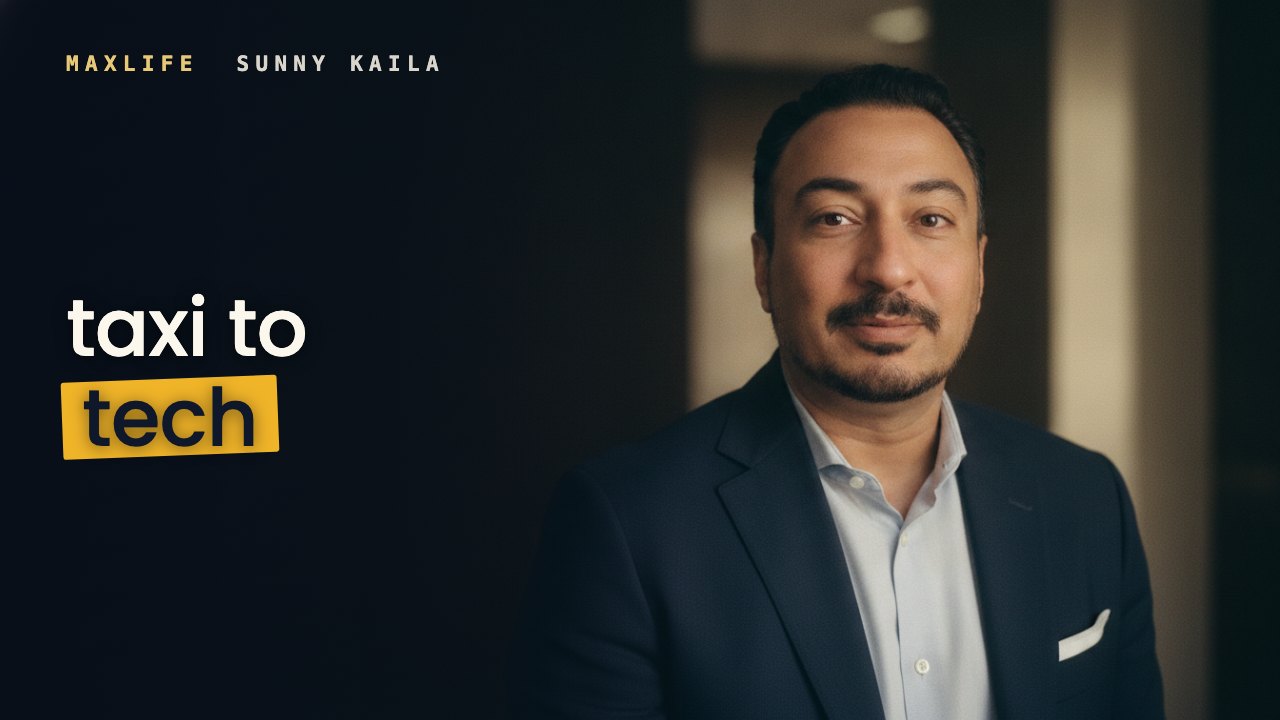
Does the American dream still exist? Sunny Kaila's answer is 100% yes
The most common pushback Sunny hears is some version of: "You came at a lucky time." His response is patient and direct. "It exists for growth-mindset people, not for victim-mindset people." He's not dismissing structural reality, he's pointing at the one variable that was always in his control. When he arrived in New Jersey in the early 1990s he had a high school diploma from a Punjabi village, no English beyond the basics, and no network. He pumped gas his first year because he wasn't old enough to hold a taxi license. The American dream, in Sunny's telling, is less a promise and more a return on a specific kind of effort, the effort of someone who asks "what can I create?" instead of "what is against me?"
From Indian village to New York City cab driver: the origin story
Sunny grew up on a farm in rural Punjab in the 1970s, a place where the expected path was clear: become the next generation of farmers. His grandfather took pride in that continuity. But Sunny's father was open to something different, and Sunny himself was already dreaming at a different scale. "If I do need to leave my village and my friends and my family, why do I need to leave for just the closest city?" he tells Ben. "Why go to New Delhi when I can just go to New York?" He prayed over three slips of paper, medical college in Russia, medical college in India, blue-collar America, and pulled blue-collar America. He took it as direction. Within two weeks of landing in New Jersey he was looking at the Statue of Liberty from the Jersey side because he didn't have $12 for the ferry. Within a year he had his taxi license and was working 5 p.m. to 5 a.m., seven days a week.
How to start a managed services company, the version nobody teaches
Sunny didn't read a playbook. He noticed a billboard for Hudson County Community College on his way into the city, stopped, picked up a catalog, and found a name that looked Punjabi, Dr. J.S. Duko, Assistant Dean of Science and Technology. He made the man his uncle on the spot and asked for guidance. The advice: forget medicine, "be a computer doctor." This was 1995. Windows 95 had just shipped. Sunny enrolled, transferred to New Jersey Institute of Technology, graduated in 2000, and was earning six figures as an IT director within two years. In 2003 he gave that up, again, to found IT by Design in New York City, serving law firms, PR agencies, restaurant chains, and Wall Street hedge funds as their outsourced IT department. The pattern held: give up a comfortable income to reach the next level. "I have to give up to go up," he says. "Money is not that important to me, even taxi drivers can make money." By 2007, Wall Street clients were demanding 24/7 coverage. Hiring night-shift engineers in New York City was nearly impossible. Sunny did what he'd always done: he ignored the border. He opened a global delivery center in India, leveraged the time-zone advantage, and built a capability none of his local competitors could match. They started asking to borrow it. He packaged it as a white-label service. Competitors became clients. "Your unique strength and your unique capability has the power to convert your competitors into clients, into collaborators." Today IT by Design employs 800-plus professionals across the US, Canada, India, and the Philippines and is recognized as the number one privately held MSP of MSPs in its space.
Chardi kala: the gratitude and courage philosophy behind the growth
Ben asks Sunny where his near-constant state of gratitude comes from. Sunny points to two sources. The first is a concept from his Sikh faith: shukrana, acceptance of what is not in your control, combined with chardi kala, the practice of showing up with courage and positivity no matter how hard things get. The second is perspective. "Being born in America is luck," he tells his own kids, who were born here. "You know how many billions of people in this world wish they could be born in America?" He takes them to other countries deliberately. He volunteers at homeless shelters and shares his story there too, not to minimize anyone's struggle, but to redirect attention toward the controllable list. Don't complain. Create. That's the operating principle.
The Statue of Liberty moment, and what it actually means
In 2022, Sunny's annual Build IT Live conference held its off-site party on Liberty Island, the same island he'd looked at from the Jersey side in 1994 because he couldn't afford the ferry. Four hundred-plus customers, a DJ, Gary Vee as keynote speaker, the American flag overhead, the Freedom Tower to the left. Sunny was in tears. "This can only happen in America," he says. "I don't deserve this", and he clarifies immediately: he means it in the sense of receiving more than you ever expected, not in the sense of unworthiness. The gratitude wasn't for his own achievement. It was for his wife, his family, his team members, 80 of whom have been with the company for more than a decade, and for a country that, in his words, "gave me that life, my future, that was not possible in my village in India."