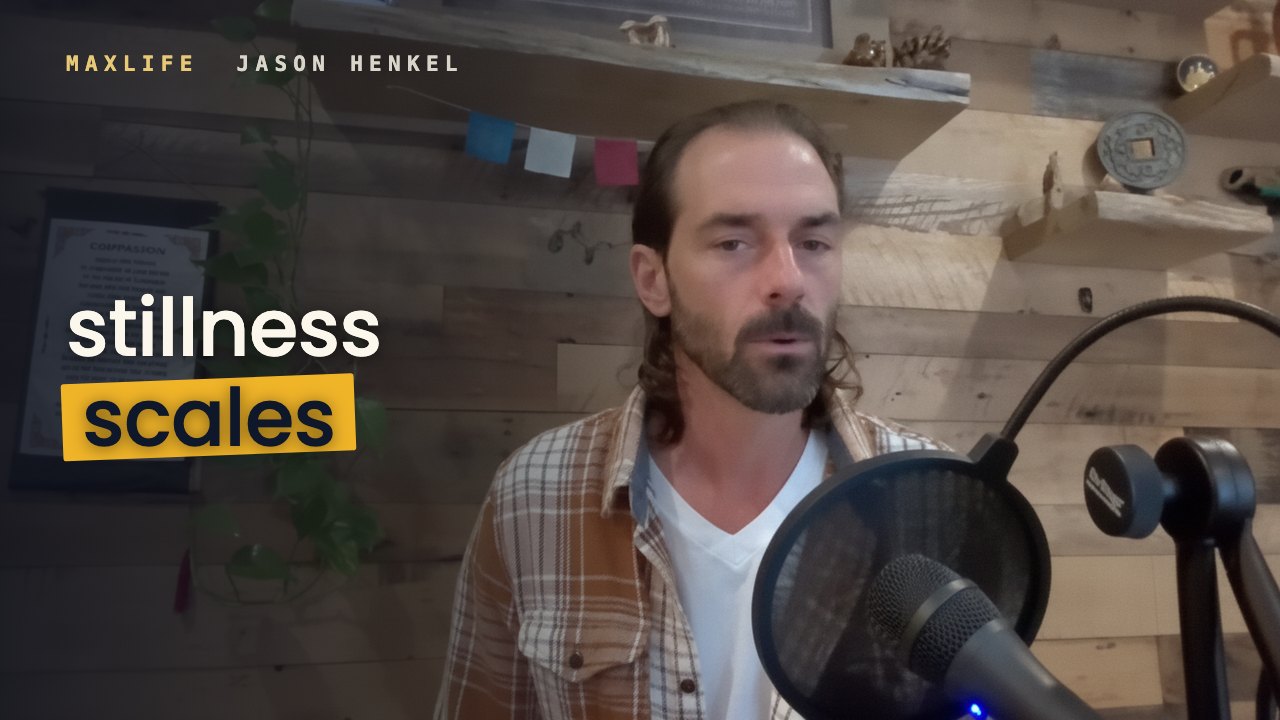
Why hustle culture is failing entrepreneurs
Most high performers aren't failing because they lack discipline. They're failing because they've confused activity with progress. Jason Henkel opens the conversation with a simple challenge: "Tell me about tomorrow." The blank stare he gets back from executives is, he says, the whole problem. A Harvard Business Review study found that 86% of what's in the average knowledge worker's inbox has nothing to do with their essential daily work. We're not productive. We're just moving.
The dopamine economy has hijacked us. We check digital inboxes between 70 and 390 times per day, not because we're weak, but because we're human. "If you are looking at email a lot and you think you're just a distracted person by nature," Jason says, "actually it means you're a healthy person who has an operating system that's functioning well. It's just you have exposures that our species didn't evolve with."
How to avoid burnout as an entrepreneur
Burnout isn't a calendar problem. It's a connection problem. Jason describes the habitualized operating state of most entrepreneurs as hurried, busy, distracted, and some form of tired or burned out, and argues that the antidote isn't another productivity app. It's moving at the pace of your wisdom. "That's a very different pace than this world is moving in," he says, "and it takes crazy courage."
He traces his own burnout back to what he calls the disease to please, a pattern he picked up from a loving but self-sacrificing mother and carried into a fast corporate climb. "It was so far the hardest shadow I've had to integrate," he admits. The work wasn't tactical. It was inner engineering: auditing belief structures, sitting with the narratives that were running him, and choosing a different atmosphere on purpose.
Practical anchors matter too. Jason points to deliberate breathing, scheduled unfocus breaks, vibrational resonance through music and nature, and the Schumann resonance, the earth's atmospheric frequency of 7.83 Hz, which is identical to human flow state frequency. Forest bathing, he notes, has been shown in lab studies to lower cortisol by up to 17% through phytoncides emitted by tree bark. "This nature walk thing is not woo. It's proven in labs."
Is hustle culture dead, or just broken
Jason doesn't say hustle is worthless. He says it's being drawn from the wrong source. Power comes from stillness. Force comes from guilt, shame, and duty. He uses Bruce Lee as an unexpected spiritual teacher: asked what the highest technique was, Lee answered almost before the question was finished, "to have no technique." In a fight, he said, "I never strike. It strikes all by itself." That's flow. That's power instead of force.
The left hemisphere, what Jason has nicknamed Dozer, is fast, decisive, and a bully. It's useful. But the right hemisphere, given time and stillness, sees the system instead of just the object. "Point to up," Jason says. Your left brain answers immediately. Your right brain, given space, realizes we're on a spinning planet orbiting a sun orbiting a galaxy orbiting a cosmos, and "by the way, there's officially no up." That systemic, meandering mind is where human genius lives. And we're punishing people for using it.
AI augmentation vs. outsourcing your thinking
The most urgent warning in this conversation is about AI. MIT published a study showing that most GPT users are experiencing a 47% decline in brain utilization, because they're using it as an advanced Google rather than a thinking partner. Jason runs a program called AI Advantage specifically to close this gap. "I want to be the sherpa that trains the sherpas that can help people use AI in a way where you get augmented, not outsourced."
His entry-level prompt tip: whenever you think the words "huh, I wonder", finish the sentence and ask GPT. His intermediate tip: ask GPT to ask you clarifying questions, one at a time, until it's 100% certain it understands your mission. "It'll ask you questions you're like, 'Whoa, right. Thanks for clarifying that one.'" The practice has made him a sharper questioner in every real-world conversation. Ben Laws frames the stakes clearly: the wealth divide of the next decade won't be about money. It'll be about who's willing to think deeply and who outsourced that too.
The real source code of high performance
Jason's company is called Focus to Evolve, but he says the full sentence would be focus and unfocus to evolve. The athletes who perform at the highest level sleep long hours, nap deliberately, and live, in his words, "very boring lives." LeBron James isn't in Vegas. He's sleeping. The same principle applies to business, we just haven't been paying attention.
The question Jason leaves every person with is this: are you satisfiable? If you can't describe what satisfaction looks like for you, you have no chance of ever feeling it. "To be a satisfied man or a woman is power. The rest is force and it's exhausting."