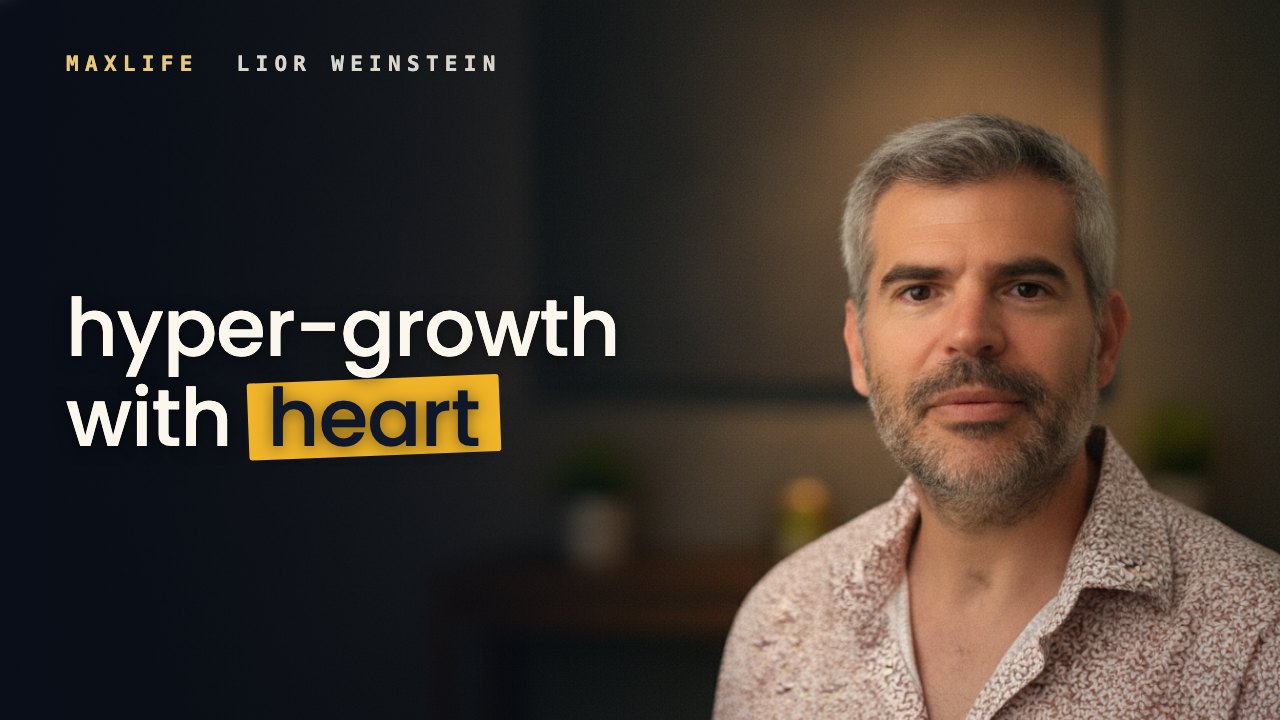
How a tech entrepreneur builds hyper-growth companies without going numb
Lior Weinstein has spent his career at the intersection of technology and human systems, as a serial entrepreneur, fractional CTO, and CRO who has built and exited multiple companies. But the throughline of this conversation isn't a framework for scale. It's a question: how do you stay connected to yourself while building fast? Lior's answer starts in childhood and keeps circling back to it.
Growing up in Israel: adversity as a calibration tool
Lior grew up in Israel in the 1980s and '90s, when suicide bombings were becoming a regular feature of civilian life. He remembers Desert Storm, gas masks, and safe rooms. His grandparents were Holocaust survivors, his grandmother was in Auschwitz under Dr. Mengele and never spoke about it; his grandfather was interviewed by Steven Spielberg's documentation project and lost nearly his entire family. "If you ever met them, you'd be like, 'These are the happiest people I've met.'" That resilience, absorbed by osmosis rather than conversation, became Lior's baseline. When something hard happens in business now, his internal benchmark is simple: am I getting shot? No. Okay, let's continue.
Anticipation vs. anxiety: the entrepreneur's real choice
One of the sharpest ideas in this episode is Lior's reframe of anxiety. "Anticipation has interesting energy because when you say anticipation, you're thinking about something that hadn't happened yet and might not happen at all, but it's very positive. Anxiety is the same energy, but it's things that hadn't happened yet, might not happen, but they're negative." He applies this directly to travel, to business uncertainty, and to the general practice of being an optimist. It's not denial, it's a deliberate choice about where to point the same fuel.
Long-form travel as a leadership practice
Lior and his wife travel with their three kids, ages 9, 6, and 4, for weeks at a time, often internationally. They took two carry-ons and two backpacks to Japan for three and a half weeks. They book the next trip while still on the current one, because they know that returning home means falling back into patterns that make months disappear. "Every time we traveled we reminded ourselves." The practice isn't about escape. It's about creating distinct, countable memories, and staying in a posture of anticipation rather than routine.
Emotional intelligence and the childhood wounds underneath the CTO
About eight years ago, Lior and his wife started doing experiential self-development work, courses, workshops, and most recently a guided couples cohort working through Harville Hendrix's Getting the Love You Want. The book maps childhood unmet needs directly onto adult relational patterns, and Lior found it confronting. "I realized I'm starting to become way more attuned to what I want. And I think what I've learned through the process is there's something in my childhood that depressed me being connected to what I want." Years of being the solver, the fixer, the CEO had crowded out the signal of his own desire. He's working on that now, and he's doing it with other couples on Zoom, which he says is part of the point: you realize you're all pretty basic, and that's comforting.
Active gratitude vs. passive gratitude
Lior draws a clear line between noticing a beautiful moment (passive) and stopping to label it out loud and share it (active). "Just stopping and saying, isn't this amazing? Just like physically saying this." He watched a whale breach at sunset in Maui and called it out to the people around him. The act of naming it reinforces the habit, creates a feedback loop, and, like a yawn, makes it infectious. He credits his friend Chris Johnson, who keeps a gratitude journal with over 1,300 entries in a single month, as a model for what that muscle looks like fully developed.
Why entrepreneurs need to learn to celebrate
Lior admits he's genuinely bad at receiving celebration. Birthdays make him uncomfortable. Attention directed at him triggers an immediate withdrawal. He traces it to something in early childhood that he's still excavating. But he's also clear that celebration is a skill worth building, not a personality trait to accept. His workaround: he celebrates his kids extravagantly, including half-birthdays, giving the family ten celebrations a year. "For other people, I love it. For me, it's hard for me to receive." He's learning to close that gap.
Automate everything but love
The title of this episode isn't a slogan, it's Lior's actual operating philosophy. Technology can handle almost every repeatable process in a business. What it can't handle is the relational, emotional core: the moment you stop and say this is amazing, the willingness to sit with a childhood video you don't recognize, the choice to suffer less. Those require a human. That's the space Lior is most interested in.