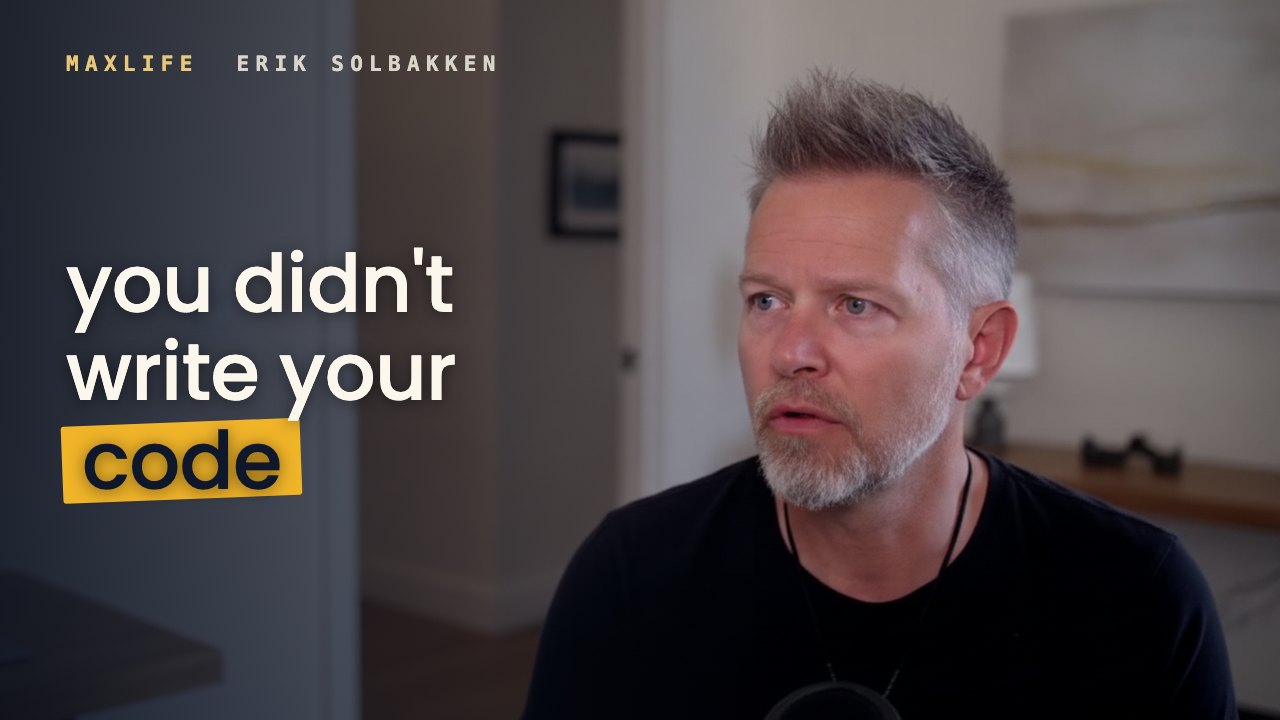
How to reprogram your mindset by seeing the program first
Most people trying to change their behavior start with habits, routines, or willpower. Erik Solbakken thinks that's the wrong entry point. "We're conditioned," he says, "and once you start seeing that, all of a sudden you're like, 'Oh, that's why I'm feeling that way.'" The reprogramming doesn't start with a new system. It starts with noticing the old one.
Erik draws a straight line from the lizard brain to the comment section. The same adrenaline spike that once protected ancestors from predators now fires when someone posts something nasty on TikTok. The saber-tooth tiger is gone. The program is still running. And until you see it, you keep reacting as if your life depends on it, because your nervous system genuinely thinks it does.
This is why Strategic Coach resonated so deeply for him. "It's the world's greatest philosophy program wrapped in a business blanket," he says, "because the minute you change the way you're thinking, you're reprogramming yourself." The tools matter less than the shift in perspective underneath them.
Identity excavation: who are you under the conditioning?
Erik spent years building toward a chartered accountant partnership. He got there. Then alcoholism took it apart. What he found on the other side wasn't failure, it was the first honest look at who he actually was underneath the credentials.
"That was my complete utter personal and professional decimation," he says. "But then I look at it and I go, that was the best day of my life." Seventeen years sober, he now coaches entrepreneurs through the same excavation: not adding more achievement on top of old programming, but digging down to find what he calls the divine spark.
The question he keeps returning to is deceptively simple: who the hell are you? Humans are the only species born without an operating manual. Every other creature just does its thing. We spend decades doing what we were told to do, then wonder why it feels hollow. The excavation is the work of a lifetime, and Erik is clear he's still in it. "I'm not the guru," he says. "I'm exploring like everybody else."
The three through-lines across every philosophy
Erik has been reading across traditions, from the Bhagavad Gita to the Kolbrin Bible to Marcus Aurelius, and he keeps finding the same three ideas. First, life is hard, and that's not a problem to fix. Second, changing how you think about what's happening changes your entire experience of it, and that shift is completely within your control. Third, your life, with all its highs and lows, is actually a gift, one that belongs entirely to you.
He illustrates the third point with a hockey game. Two fans, same game, completely different experiences. One ecstatic, one devastated. "We all watched the same game. We all watch life happen the same way, but yet this guy's pissed off and this guy's happy." The event is neutral. The conditioning colors everything.
The stoic version comes from Marcus Aurelius: "If you feel you've been harmed by another, you've been harmed. But the minute you change your mind and say, 'I haven't been harmed by another,' you're no longer harmed." Erik finds that line genuinely useful, not as a way to dismiss real pain, but as proof that the interpretation is always available to you.
Feeling the hard feelings as a reprogramming tool
One of the most practical threads in this conversation is what Erik calls letting energy flow through you. When a feeling arrives and you block it, resist it, or decide you shouldn't be having it, it doesn't leave. It lodges. It shows up later as a trigger, a pattern, a reaction you can't explain.
Ben shares his own experience after losing his son Benny: sitting in Starbucks with tears streaming, watching a sunrise on a plane and just crying. Not performing grief, just letting it move. "There was a lot of freedom in actually feeling those feels," he says. Erik connects that directly to the energy work he's done with healers: "When energy comes into you, let it flow through you. The minute we block it, it traps energy in the body."
This isn't woo-woo for its own sake. It's a practical argument for why high performers who pride themselves on emotional control often carry the most unprocessed weight. The feelings you don't feel don't disappear. They become the programming you're trying to reprogram.
Entrepreneurs and the divine spark
Erik pushes back on the idea that entrepreneurship is purely about money or status. He sees the drive to build, improve, and create as something older and deeper, what the Gnostic texts call a spark of divinity that each person carries but can't quite see. "There's something inside us that goes, 'I'm not comfortable with just everything being the status quo,'" he says.
The bored entrepreneur who starts fires just to put them out isn't being destructive for no reason. They're reaching for something. The work is learning to direct that reach inward, toward identity excavation, rather than outward into manufactured chaos. A mind that is constantly learning, as Krishnamurti put it, can never be hurt. That's the Viking ethos translated into daily life: not reckless aggression, but full engagement with whatever is in front of you, sword in hand, eyes open.