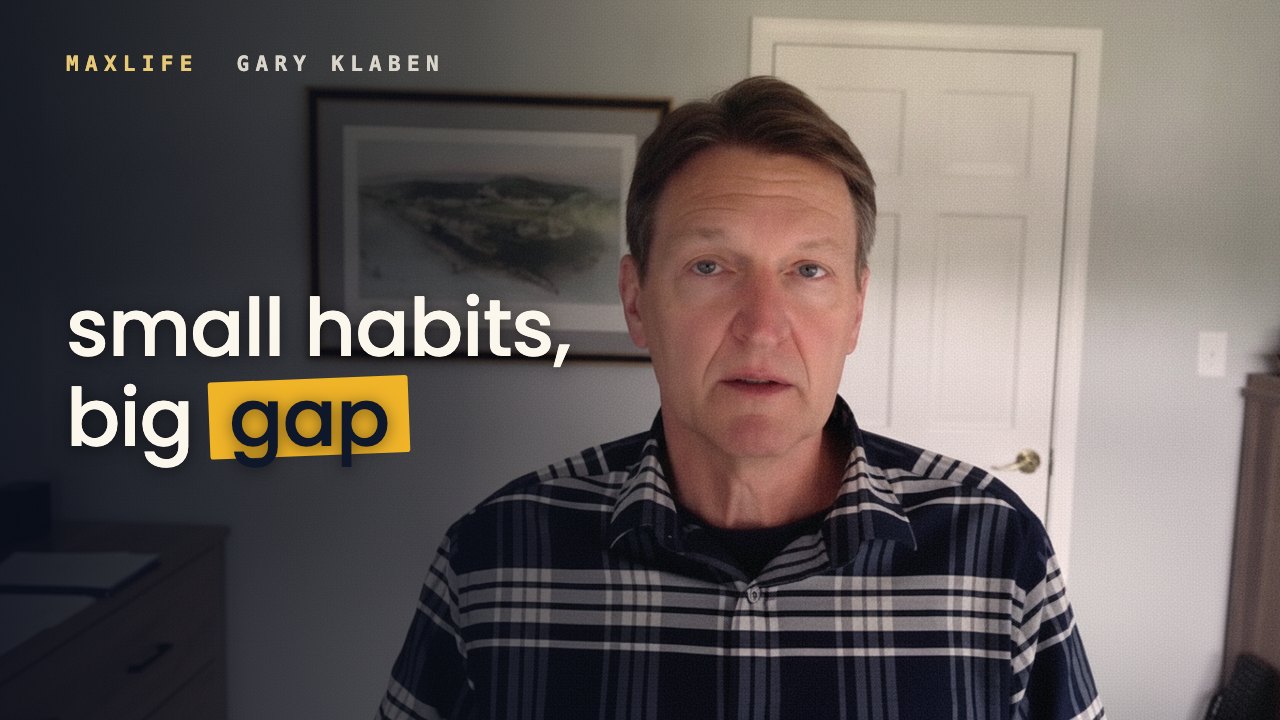
The six habits of high performers Gary actually lives
Gary Klaben is 68 years old, has three concurrent heart conditions, has been hospitalized 51 times, and still runs six days a week. When people ask how he keeps performing at that level, he does not talk about morning routines or productivity apps. He talks about six things he calls non-negotiables: sunlight, clean air, clean water, sleep, daily movement, and clean food. "If you're just operating at a high level all the time because your faculties are good, then when things come along, you just have that little bit of edge," he says. These are not hacks. They are the floor. Miss them and the edge disappears before your first meeting.
Gary started running at 14 after reading a book called LSD, Long Slow Distance, written by a 62-year-old who claimed you could run well into your 60s if you trained that way. Gary made a decision at 14 and has been running for 55 years. The six habits did not arrive as a system, they accumulated because he was living and feeling the results. Sleep improved his performance. Clean food sharpened his mind. The system built itself around the commitment.
How to build grit: the West Point definition
Angela Duckworth's research on grit started, in part, with West Point cadets. Gary lived it. Every single person who goes through the academy fails at something, and for many of them it is the first time in their lives they have ever failed. "The people who had never failed before had an unbelievably difficult time," Gary says. The ones who made it through were not the strongest or the smartest. They were the ones who kept going when the ruck march gave them blisters, when the cold calls went nowhere, when the paper was due at 2:00 a.m.
Gary's definition of grit is not complicated: it is picking yourself up and persevering when the odds are against you, specifically at the moment when most people stop. He ran through severe abdominal pain at 15 on a 12-mile run, decided he was not going to stop regardless, got through it, and the pain never came back. "Most of it's in your head," he tells people who ask why he never gets injured. That is not dismissiveness, it is a lesson he earned by testing it on his own body for five decades.
Mindset shifts for entrepreneurs who want to stop burning out
Gary spent years making cold calls in financial services. After four months, he was the only one left out of seven who started. He remembers sitting in a parking lot telling a colleague that some days cold calling was harder than Ranger school. The difference between him and the six who quit was not talent. It was the refusal to treat the headwind as a reason to stop.
Ben Laws draws the parallel to biking: if you keep going long enough, the headwind becomes a sidewind, then a tailwind. Gary's version is simpler. "You're paying too much attention to this thing here, and you're not going here," he says, pointing from the obstacle to the direction of travel. The mindset shift is not positive thinking. It is redirecting attention from the blister to the finish line.
For entrepreneurs, Gary adds one more layer: you cannot do it alone, and pretending you can is its own kind of failure. At West Point, if your buddies are not there for you and you are not there for them, nobody graduates. The same is true at Strategic Coach, in a startup, or in a family. Isolation, Gary says flatly, is worse than cold calling.
Grit and resilience start with humility
Gary has been reading the same book on humility, Humility of the Heart by Cajetan Mary da Bergamo, for three years. He keeps going back because he believes humility is the one attribute that keeps everything else working. Every saint, the book argues, had one thing in common: humility. Not intelligence, not discipline, not charisma. Humility.
The catch is that you cannot manufacture it. "If you try to be humble, you can't. If you try to read about humility, you can't. It's a being." What Gary does instead is read about it so that examples of it stay close, and then he tries to let it happen automatically. In practice, humility shows up as curiosity, treating the person in front of you as someone who probably knows more than you do, the same way Ben turned cold calling into a research project on human behavior and started booking 14 to 18 appointments while everyone else got two.
West Point leadership lessons and the family village
The family village did not start as a real estate project. It started in 1991 when Gary drove home after signing estate documents for a client and felt sick. He realized the children were not ready for the money, and that transferring it would destroy them. That moment reoriented his entire practice around one question: how do you pass along not just the money, but the grit, the values, and the purpose that created it?
Three decades later, Gary and his wife found a 67-acre property with five families now living on it, his daughter and son-in-law, his grandson, his in-laws, and two brothers with their spouses. Nobody was recruited. They asked to come. The one non-negotiable Gary set for the property: "Everyone who comes here should be able to pursue their purpose in life, whatever that is, and we will provide the support, the resources, the money, whatever is necessary so they can pursue what God put them on the earth to do." That is the whole model. Everything else is logistics.