Why vulnerability in leadership starts with honesty, not performance
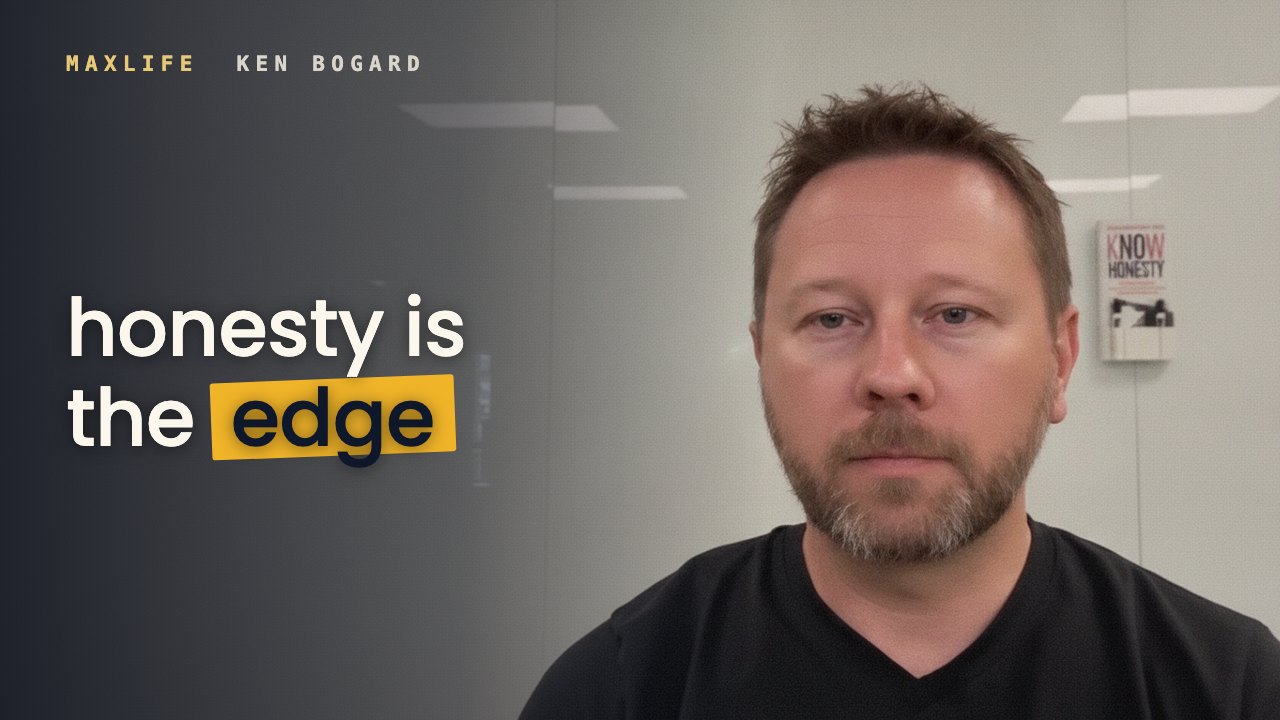
Ken Bogard opens with a provocation: the leaders most celebrated for authenticity are often the least honest in their day-to-day communication. The last 15 years have handed us three powerful cultural trends, authenticity, the power of vulnerability, and identity, but Ken argues we have been handed only half the equation. "Where is the we collectively?" he asks. "How do we hear one another? How do we give people the space to be who they truly and freely are?" His book No Honesty adds a fourth pillar: openness. Together, honesty and openness form what he calls the real competitive edge most leaders are ignoring.
Open and honest communication at work: what it actually requires
Ken defines open and honest communication with unusual precision. Honesty is speaking into what you truly want and how you truly feel, no politicking, no worm-turning, no facade. Openness is listening without reservation and putting your own needs and wants on pause for another person. "If all my leadership team members can be 100% honest and 100% open in their communication," he says, "we are unstoppable." The problem is that neither quality is taught, not by parents, not in grade school, not in high school, not at a first job. Social media fills the vacuum, and it fills it badly.
How to improve team communication by removing the walls
Ken identifies the primary blockers of open communication as what he calls walls: fear walls, control walls, preference walls, and ego walls. They go up the moment a boss criticizes, a political opinion surfaces, or a dinner is not on the table. The practice he teaches is two-part. First, identify historical walls, the moments in your past where a wall went up and cost you a real connection. Second, catch the wall in the moment. "When you feel the wall come up, that's the thing Ken was talking about. Time to push it down. Just be open to the experience that's taking place." He ran this exact exercise with his own family: same scenario, same messy house, same tired wife, but a shifted mindset turned anger into gratitude.
Vulnerability in leadership and the problem with "fake it till you make it"
Ken is direct about one of the most repeated pieces of career advice: fake it till you make it is, in his words, "some pretty poor advice and a really good way to build shells and fake yous all over the place." His partner Grace Gavin offers the replacement: do it afraid. People read fakeness immediately. The leaders who build the deepest loyalty, Ken points to Gino Wickman of EOS as an example, are the ones who decided to show up as the same person to every room. That consistency is not weakness. It is the foundation of trust, and trust is the foundation of retention.
Why disagreement is the genesis of high-performing teams
One of Ken's most counterintuitive claims is that disagreement is not friction, it is information. "Disagreement is okay. It's as prevalent as oxygen and we need to be way more accepting of it." The failure mode he sees most in leadership teams is not too much conflict but too little honest disagreement. When people stop putting their real perspective on the table, alignment becomes performance. Decisions get made on incomplete information. And the team slowly stops trusting each other because everyone can feel the gap between what is said and what is meant. The fix is not a communication workshop. It is an agreement: we will be honest, and we will be open. Both. Every session.
The social and cultural roots of our honesty deficit
Ken traces the acceleration of disconnection to 2012, the moment social media became a primary platform for human interaction. The cell phone removed eye contact. Social media replaced depth with volume. And the result is what Jonathan Haidt documents in Anxious Generation: loneliness, anxiety, and depression at historic levels. Ken's diagnosis is blunt: "We are turning into a me, myself, and I society. There's no teammanship. There's no collaboration." The antidote is not nostalgia, it is a deliberate practice of openness, one conversation at a time. His sessions, his book, and his assessment tool are all built around that single belief: if we can teach people to listen without reservation, the pendulum will swing.