MaxLife Podcast · Episode

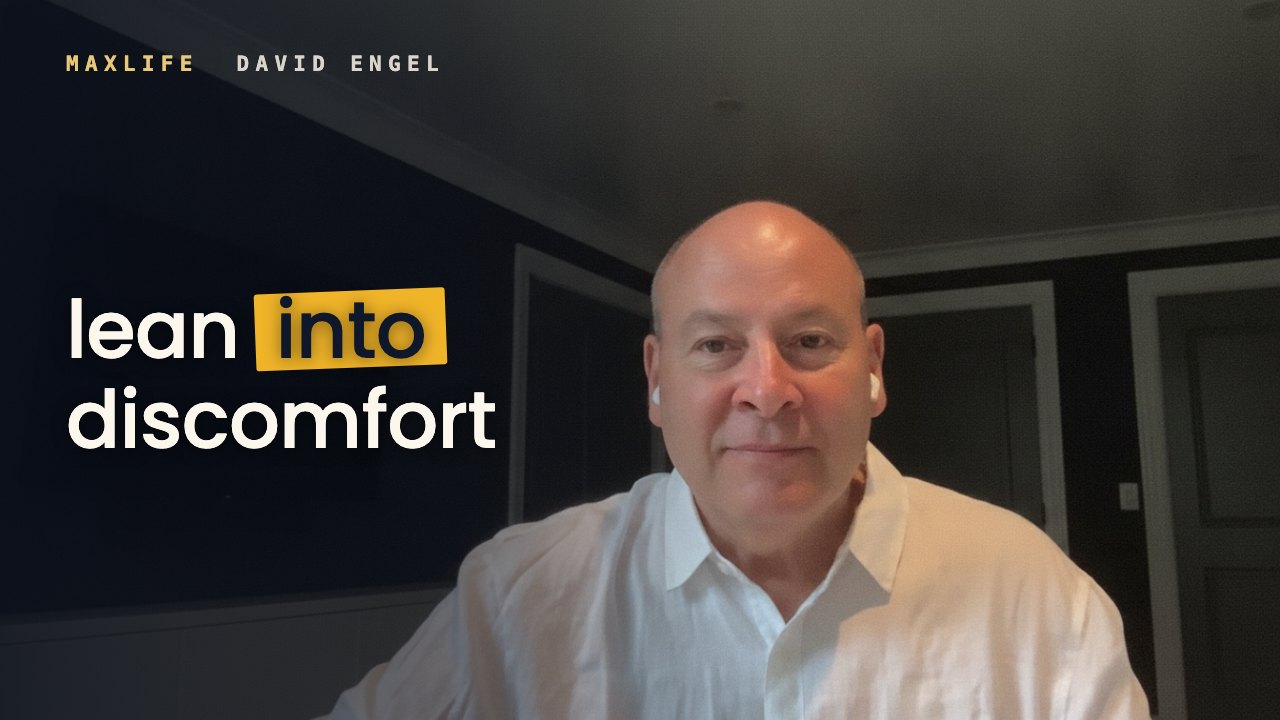
Why Discomfort is the Secret to Real Confidence with David Engel

Most people treat discomfort as a warning sign. David Engel treats it as proof he's moving forward. A conversation on change, confidence, failure, and why relationships are the whole game.

With David Engel1h 2mConfidence · Change · Relationships
The short version

Real confidence isn't the absence of fear or discomfort, it's the practiced willingness to move through both. David Engel, a 30-plus-year marketing veteran, argues that change is a catalyst for growth and that if you're not uncomfortable once or twice a month, you're probably not moving forward. He draws a sharp line between problems (health is a problem) and challenges (everything else is a challenge and an opportunity), and insists that failure is the impetus to get back on the bus, not a reason to get off. At the core of every success story he tells, it's the same thing: relationships, confidence, and the courage to ask the question everyone else assumed was a guaranteed no.

Key moments
What you'll take away

9 ideas from this conversation

01

Discomfort signals forward motion

David checks in on discomfort deliberately: if he's not uncomfortable once or twice a month, he considers himself stalled. Discomfort isn't a warning, it's a compass.

02

Change is a lifeblood, not a threat

"Change is a catalyst for growth and the catalyst to be present and current in your business." Fighting change is fighting the thing that keeps you relevant.

03

Failure is the impetus, not the end

Entrepreneurs only share their wins publicly, but the failures are what push them forward. The question isn't whether you'll fall, it's how quickly you get up.

04

Ask the question everyone else skips

Not asking is a guaranteed no. David's biggest wins, from Procter & Gamble paper advances to Reader's Digest retainers, came from asking questions that felt too obvious or too bold.

05

Relationships carry you through the hard parts

Every major mistake David describes resolved through a relationship. "If you have confidence in your relationship, you handle a problem right away. It works out."

06

Charge for wisdom, not just work

Dan Sullivan pushed David to recognize that clients weren't paying for equipment, they were paying for wisdom. Naming that shifted everything about how he priced and positioned himself.

07

Problems vs. challenges is not just semantics

In the Engel household, health is a problem. Everything else is a challenge or an opportunity. The word you use shapes how your brain responds to what's in front of you.

08

Confidence is multifaceted, not one number

"Success is so multifaceted", business, family, community, personal. Treating it as a single scoreboard is the fastest way to feel like you're losing when you're actually winning somewhere else.

09

Time is the one thing you can't get back

David's closing echo: "The only thing you can't get back is time. Use it well, respect it, and don't waste it." Every other resource has a workaround. Time doesn't.

Full show notes

Why Discomfort is the Secret to Real Confidence with David Engel

Why discomfort is the secret to real confidence

Most people treat discomfort as a stop sign. David Engel treats it as a green light. After more than 30 years in marketing, from pressing vinyl record labels to building a retainer-based consulting practice for major Canadian banks, David has one consistent through-line: if you're not uncomfortable once or twice a month, you're probably not moving forward. "I view discomfort as a catalyst for moving forward or not," he told Ben. "You have no control over change. So you might as well accept it and make it work for you."

That's not a motivational poster. It's a operating principle David has tested across decades of real business risk, including selling a $10,000-a-month innovation platform to the Royal Bank of Canada before he'd figured out how he was going to deliver it. "First you make it up," he said, "and then you make it happen."

How to build real confidence when the outcome isn't guaranteed

Confidence, David argues, isn't certainty. It's the practiced willingness to act without a guaranteed outcome and to find value in both results. "There's value in succeeding and there's greater value in not succeeding," he said. "Some things work and some things don't work." He traces his own confidence back to a father who never said no, who sent him to New York at 24 to pick up printing film for Apple Records at midnight, who let him negotiate a 50% paper advance from a client to fund a press purchase the company couldn't otherwise afford. The safety net wasn't money. It was permission.

Dan Sullivan of Strategic Coach pushed David to formalize what his clients already knew: they weren't paying for equipment or deliverables. They were paying for wisdom. Sullivan's exercise, writing to your 10 best clients and asking them to name three reasons they work with you, produced the same answer every time: "You come to us with new ideas, you teach us things, you solve our problems, and you never let us down." That clarity became the foundation of a retainer model David still uses today.

Why failure is your greatest teacher in business

David doesn't hide his mistakes, he catalogs them. A $350,000 glue error on a print job that a client refused to pay for turned into millions of dollars of future work because David handled it with honesty and confidence in the relationship. An undercapitalized growth phase taught him that cash confidence matters as much as sales confidence. A bank that turned him down for a $100,000 line of credit when he had a Procter & Gamble order in hand taught him that banks aren't always your best friend, and that the client often is.

"Entrepreneurs don't tell you the times that they fail," David said. "They only tell you the times that they succeed. But the failures are the impetus to get up and go on." His skiing analogy says it plainly: you master the bunny hill, then you have to go to the intermediate run even though you know you'll fall. "The question isn't if you're going to fall. The question is how quickly you get up."

Why relationships define a meaningful life

Ask David for his top advice to a 25-year-old and the first word out of his mouth is relationships. Not strategy. Not capital. Not hustle. Relationships. He's been married 47 years. He has three kids who married people he considers his own. He volunteers. He reaches out to non-clients who said no just to ask what attributes they value in partners, because the relationship matters more than the transaction.

"The things that you think you've done wrong, nobody ever notices them," he said. What they do notice is whether you showed up, whether you were honest when something went sideways, and whether you brought them something new. That's the whole game. Confidence gets you in the room. Relationships keep you there.

The one thing you can't get back

Ben asked David to close with a ripple, one phrase to echo out. David didn't hesitate: "The only thing you can't get back is time. Use it well, respect it, and don't waste it." Every other resource in this conversation, money, confidence, relationships, even reputation, has a path back. Time doesn't. That's not a warning. It's an invitation to treat every uncomfortable moment, every hard conversation, every risky ask as exactly what it is: the thing you came here to do.

Quotable

Lines worth sitting with

I look forward to change because change is a catalyst for growth and the catalyst to be able to be present and current in your business.
David Engel
If I'm not uncomfortable once or twice a month, then I view myself as not moving forward.
David Engel
Entrepreneurs don't tell you the times that they fail, they only tell you the times that they succeed. But the failures are the impetus to get up and go on.
David Engel
The only thing you can't get back is time. Use it well, respect it, and don't waste it.
David Engel
Free · No. 39 of the series

I want to build real confidence, not just avoid the hard stuff
Reflection Worksheet

The episode is 1h 2m. This worksheet is fifteen minutes. The fifteen minutes is the part that changes anything: five questions from this exact conversation, pointed at your business and your life. Answer them on paper while the ideas are still fresh, and they become yours for good.

  • The Ask You Swallow
  • The No You Already Gave Yourself
  • Read The Discomfort
  • How Fast You Get Up
  • Just Ask, This Week
You get this worksheet plus the full 75-worksheet binder, free.
5 prompts, 1 pagePrintable, binder-readyFree, no spam
Open the full worksheet →
Clips · grab & share

Short highlights from the episode

Short clips from this episode are on the way. Watch the full episode while we cut them.
The guest

Meet David Engel

David Engel on the MaxLife Podcast

David Engel

Marketing strategist & founder · Innovative HRT

David Engel has spent more than 30 years in the marketing and print industry, from launching perfume campaigns in Vogue magazine to building an intellectual-capital consulting practice for major financial institutions. He works with the who's who of the financial sector, helping clients solve the problems that keep them up at night. His edge is relationships, wisdom, and the confidence to sell something before he knows exactly how he'll deliver it.

Questions, answered

Questions & answers

How do you build real confidence when you keep failing?
David Engel argues that failure is the impetus for confidence, not the enemy of it. Every mistake he describes, the glue error, the undercapitalized growth phase, the bank that said no, resolved into a bigger win because he stayed in the relationship and kept moving. Confidence isn't built by avoiding failure. It's built by getting up faster each time.
Why is discomfort important for personal growth?
David uses discomfort as a monthly check-in: if he hasn't felt it recently, he's probably not pushing forward. Discomfort signals that you're operating at the edge of your current capability, which is exactly where growth happens. Comfort, by contrast, can create a false sense of security and lead to indecision, which Ben and David both argue is far more expensive than a bad decision.
What is the relationship between confidence and change?
You can't be confident in a static environment, confidence is tested and built through change. David's entire career is a case study in this: every time the industry shifted, from vinyl to digital to intellectual capital consulting, his confidence came from leaning into the change rather than resisting it. "You have no control over change," he said. "So you might as well accept it."
How do relationships affect success in business?
For David, relationships aren't a soft skill, they're the primary business asset. His biggest recoveries from mistakes happened because the relationship with the client was strong enough to survive the error. His retainer model started because a relationship with a Reader's Digest president turned into a dinner conversation. He reaches out to clients who said no just to learn from them. Relationships are the infrastructure everything else runs on.
How do you stop being afraid of failure as an entrepreneur?
David reframes the question: the goal isn't to stop being afraid, it's to stay on the bus. He tells his kids that you're going to fall on the intermediate ski run, that's not a reason to stay on the bunny hill. You give yourself permission to fail, you handle the fallout with honesty and speed, and you use the experience as data. Fear of failure shrinks when failure stops being the end of the story.
What do most people get wrong about success?
Both Ben and David land on the same answer: people think success means no headwinds, no hardship, and a clean Instagram feed. David's version is more honest, success is multifaceted, it changes as you gain experience, and it has as much to do with family, community, and how you feel about yourself as it does with money. "You only realize that as you experience things," he said, "or you're open to those things."
Share kit

Help spread this episode

Ready-to-post copy for guests and fans. Grab a caption, pick a clip above, and link this page.

Copy any of these word-for-word, or make them your own. They tag the show so it shows up when you post.

Social caption — long
What if the discomfort you've been avoiding is actually the thing building your confidence? In this episode of the MaxLife podcast, marketing veteran David Engel shares 30+ years of hard-won wisdom on why change is a catalyst for growth, why failure is your greatest teacher, and why relationships are the whole game. He's launched perfume campaigns in Vogue, helped produce platinum albums, and built a retainer-based consulting practice for major financial institutions, and his through-line is simple: if you're not uncomfortable once or twice a month, you're probably not moving forward. Full episode, show notes, and a free reflection worksheet at https://maxlifecoach.com/episodes/why-discomfort-is-the-secret-to-real-confidence, @MaxLifeBenLaws
Social caption — short / quote
"If I'm not uncomfortable once or twice a month, I view myself as not moving forward.", David Engel on the MaxLife podcast. Full episode + free worksheet: https://maxlifecoach.com/episodes/why-discomfort-is-the-secret-to-real-confidence @MaxLifeBenLaws
Email — share with your audience
Subject: You have to hear this episode

Hey,

I just listened to this conversation between Ben Laws and David Engel on the MaxLife podcast and I kept thinking of you.

David has been in business for 30+ years, marketing, print, consulting, and his take on confidence, change, and failure is one of the most grounded things I've heard in a long time. He's not selling a framework. He's just telling the truth about what it actually takes to stay in the game.

One line that stuck with me: "The only thing you can't get back is time. Use it well, respect it, and don't waste it."

Full episode, show notes, and a free reflection worksheet here: https://maxlifecoach.com/episodes/why-discomfort-is-the-secret-to-real-confidence

Worth an hour.
Copied