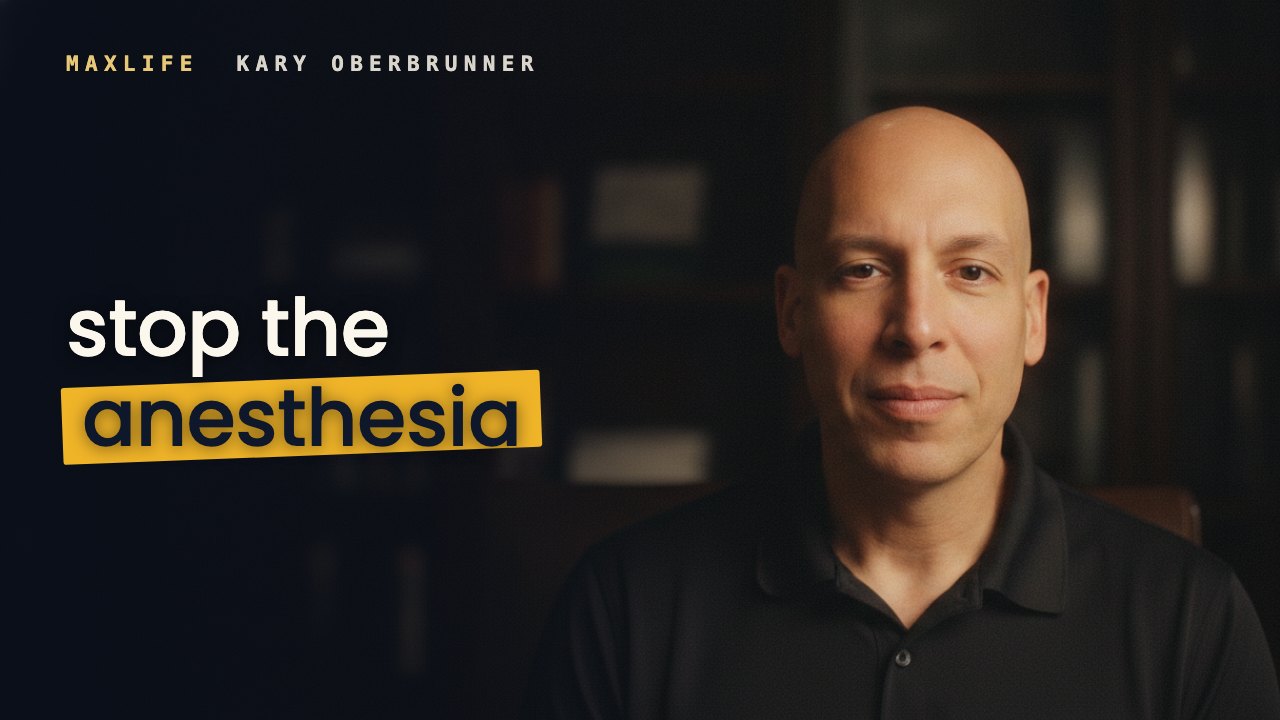
How to find your purpose in life when fear keeps you comfortable
Most people who feel called to something greater spend years performing the call without answering it. They speak at conferences about bold living while quietly cashing a paycheck that feels safe. Kary Oberbrunner did exactly that for 11 years as a pastor, and it took a coach calling him out cold to break the spell. "You can't take the ring and stay in the Shire," Chad Scott told him. Within 24 hours, Kary had resigned.
That moment is the spine of this conversation. But to understand why it landed so hard, you have to go back to Wisconsin, age 10, when Kary's parents first took him to a counselor and his dad read him an intake form asking whether he'd ever thought about suicide. He lied and said no. He had.
Childhood trauma, self-injury, and the roots of ambition
Kary doesn't soften the early story. Sexual abuse from a stranger, a mother recovering from a stroke, a household where feelings weren't discussed. The pain went inward and became self-injury. "Self-injury is really you reenacting pain but in a way that you can control," he says. "It's not that you want to die, it's that you want to live but you need a coping mechanism."
The ambition was always there alongside the pain. Kary describes wanting significance from the earliest age, but in the beginning it was raw and egotistical. The maturity came later, when he realized that the people who build something lasting stop asking what the world can give them and start asking how much value they can create for others. That shift, he says, is where real business success begins.
The decision that changed everything: leaving the pastorate
By 2012, Kary was 35 years old with three kids aged 6, 4, and 2, no business training, and a coach who had spent months calling him out for using "anesthesia words" to avoid searing truth. When Chad Scott saw photos of Kary speaking at an outside event while still drawing a church salary, he didn't ask questions. He said: "You are playing a game where you are too scared to make a move in your life, and you are using the church's dollar, and you're telling everyone in your speeches to live bold, and you are scared to death to step out." Then he hung up.
Kary called his senior pastor the next day. Eleven years, gone. The fear was real. So was the clarity.
Why people delay decisions and how to stop
One of the sharpest insights in this episode is Kary's breakdown of the word decide. Suicide, genocide, homicide, insecticide, decide, they all share the Latin root for death. To decide literally means to cut off or kill. "This is why people don't want to make a decision," Kary says, "because they have to grieve the end."
Keeping your options open feels like wisdom. It's actually a leak. You spread your limited energy across every possibility so you never have to show up fully in any one direction. A gardener who wants fruit prunes the branches. The cutting is the point.
Ben connects this to his own experience losing his son Benny at 16 days old. The grief of that loss pruned everything that wasn't real. Before Benny, Ben was living in the possibilities. After Benny, the filter became simple: is being alive the same as living?
The $5,000 leap and building from nothing
After leaving the church, Kary had no business background and very little confidence. Three mentors he cold-emailed turned him down. Then a free ticket to a John Maxwell event changed the trajectory. Maxwell announced a founders group for a new coaching team. Kary ran to the front. The cost was $5,000, close to 10% of his annual income at the time. His wife thought it was a scam.
He invested anyway. Within a year, members of Maxwell's inner team were paying him to help write their books. That single decision seeded the publishing company Author Academy Elite, which at its peak drew 600 attendees from Australia and the UK to annual events. It also led to the Shawshank Dream Job Boot Camp, where Kary literally locked aspiring entrepreneurs in prison cells and had them write letters to their former stuck selves.
Pain is inevitable, misery is a choice
Kary's three pieces of advice for anyone trying to move faster toward the life they're meant to live: first, choose acute pain over chronic pain. Chronic pain is the dull ache of a delayed decision. Acute pain is intentional, short-term, and healthy. Second, take Marcus Aurelius seriously, what stands in the way becomes the way. The obstacle you're circling is the path. Third, do hard things on purpose. Cold plunges, early workouts, cold calls, discomfort is a muscle, and Americans have been told too long that being uncomfortable means something is wrong.
"If it doesn't challenge you, it doesn't change you." That line came up at a conference Kary and Ben both attended the week this episode was recorded. It's a good summary of everything Kary has lived.