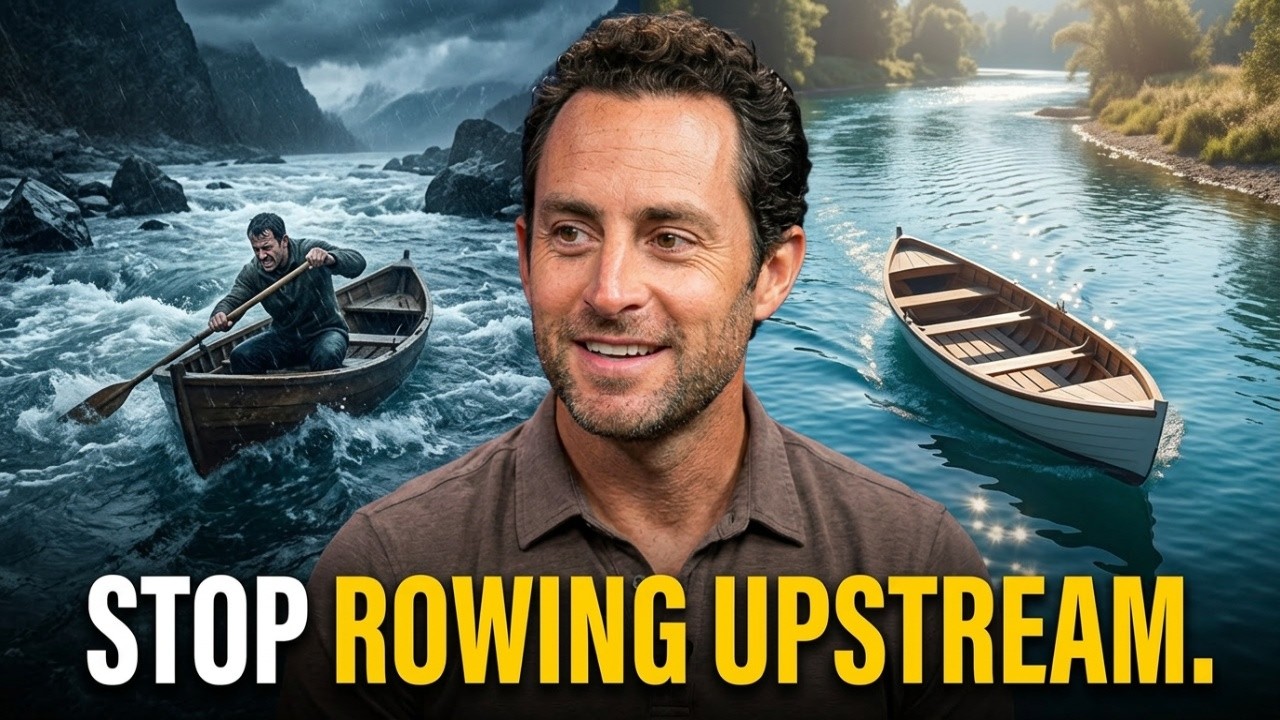
For 35 years, Ret Taylor was on the train for success: companies built and sold, ultramarathons run, big mountains climbed. He got very good at doing hard things. Then, at 18,000 feet on Denali, he realized the whole engine had been running on a story he wrote as a scared 10-year-old in a bus station. In this episode of MaxLife, Ben Laws and Ret talk about what happens when hard stops being better, and how to find the life that's actually yours.
Why "hard equals better" runs so deep
Ret traces it to one night: 10 years old, 2 a.m., a cold bus station, moving for the third time in a year. He made a vow to gain sovereignty over his life, and decided money and hard work were the way there. "I'm just going to get really good at doing really hard things," he says. It worked, which is the trap. The wins kept coming, the dopamine kept landing, and effort became not just his strategy but his identity. For a lot of high achievers, that's the quiet setup for burnout: a life optimized for proving you're enough.
What the Honest Yes actually feels like
Turning around on Denali, Ret says, "felt like the first honest yes that I'd had in a long time." He tracks it in the body. A real yes opens up your chest and gut, expansive and alive. A weaker yes lives in your head or your shoulders. "If it's not a hell yes, then for me these days, it's a no." It's a simple filter with hard implications, and most of the episode is about learning to feel the difference.
Letting go of control without it feeling like quitting
Lying in his tent with his fists clenched, Ret saw himself white-knuckling a rowboat, facing forward, steering into the rapids on purpose because suffering felt like proof. Then he opened his hands and let the oars drift. "I felt myself begin to drift backwards with the current," he says, carried into the channels most aligned with him. A couple of his teammates read the decision as quitting. He read it as not walking off a cliff. Same move, two different stories.
What is a misogi?
A misogi is a once-a-year challenge so hard you only have about a 50/50 shot at finishing. The name comes from a Japanese Shinto purification ritual rooted in the myth of Izanagi, who fights his way out of the underworld and washes off the journey in cold water. Ret has done one or two a year since 2014: ultramarathons, big mountains, a 200-mile bike ride he failed. The point isn't the suffering. "It's a deeper understanding of just how strong and capable you really are." Denali was his 2024 misogi, and it taught him the opposite of what he expected.
Why success can feel empty, and what fills it
Ret quotes research from Travis Luther, who interviewed people on their deathbeds and found many tied their sickness to a lifetime of lying to themselves, living a life that was never theirs. "Honesty is binary. It doesn't take energy," Ret says. "Misalignment, untruths, they take energy to create and to maintain." Selling his company in a distressed state wasn't the ideal exit financially, but he calls it perfect in every other way, because it gave him a runway to do the work he'd always known was his.
Boredom, nature, and the modern vision quest
The antidote to all that noise, Ret says, is boredom, and he means that literally. "Boredom is a luxury." Silence, solitude, and simplicity are where creativity comes from, and in an age where machines handle the speed and scale, the human contribution is imagination, discernment, and truth. He frames his vision quests around four tenets: simplicity, silence, solitude, and severance. The goal is to turn down the volume enough to hear what's underneath.
How to run your own mini vision quest
You don't need days or a remote cliff. Find your nearest state park, walk in, and sit longer than is comfortable. Leave the phone. Bring a journal, a blanket, a thermos. Set an open intention, not "should I start this company" but "I'm here to see what I'm meant to see," so a deeper intelligence has room to answer. Ret's closing question is the whole episode in one line: what would our lives look like if we turned up the volume on our own truth?