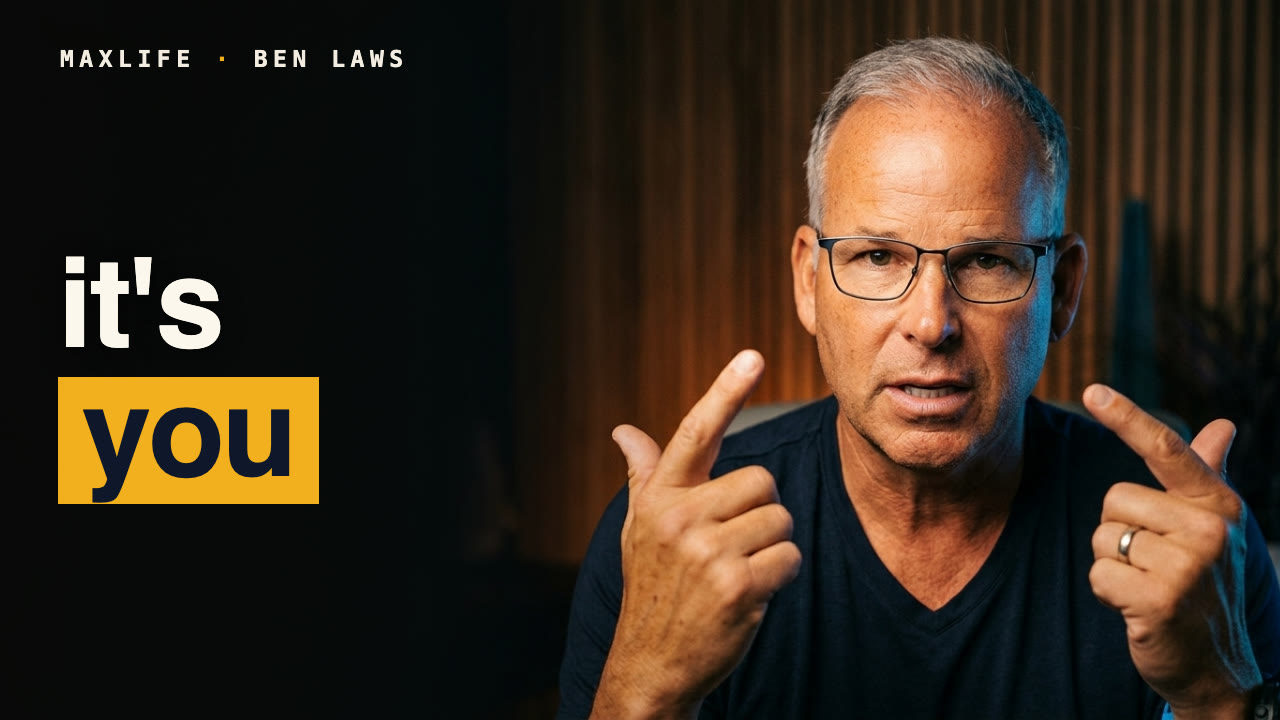
Most founders think the ceiling on their business is strategy, the market, or the right hire. In this episode of MaxLife, Ben Laws sits down with executive coach Jerome Wade (his second time on the show) for the uncomfortable answer: the ceiling is usually the founder. If you want to know how to scale a business, the first move is to stop being the reason it can't.
The owner-operator trap: a job, not a business
Wade tells the story of a client, the most networked marketer in his space, who grew a company from zero to millions and then stalled, because he was the limiting factor. "Business only has value if it goes beyond you," Wade says. "If you're the owner operator, you don't have a business. You have a job." A company only sells, transfers, or scales when it has the systems, structure, and staffing to run without a disruption when the founder steps back.
If you are the problem solver, you are the problem
The line that anchors the episode: "If you are the problem solver, you are the problem." As long as every decision passes through the founder, they cap the company's output and, ironically, make worse calls doing it. "You're dumbing down your business," Wade says, "because you're making dumb decisions as an executive leader." The fix starts with the highest-leverage decision a founder makes: who they hire. "Strategy means nothing if you don't have people to execute."
Give your people altitude
Wade's aviation metaphor for delegation is altitude: assign each role a real level of decision authority. "If you're the leader that everything has to pass through, you'll never have an elite producer on your team. And if you do hire one, they're not going to stay." The escalation he teaches is hands, head, and heart. Most leaders extract only the hands. Earning the head and the heart is what produces people who lead like owners, and it's what finally gets the founder out of the day-to-day.
Culture is your performance architecture
"No organization has no culture," Wade says. The only question is whether you built it on purpose. Accidental culture creates accidents. He calls the intentional version performance architecture, and he's blunt about the leader who controls everything: "That's not leadership. That's control."
You get what you tolerate
Standards are the quiet engine. "You get what you tolerate," Wade says, and a standard is "a decision you make before the pressure's on." Plenty of businesses tolerate status quo and average producers, and then wonder why the results are average. He also names the real reason people quit: not pay, but the people who manage them.
The inner game: the most expensive belief
The back third turns inward. Wade shares a failed year-long launch and the story it left him telling himself: "I am not enough. I don't have what it takes." That, he argues, is the most expensive belief a leader carries, because the inner game caps the outer one. The reframe he lands on: "You're the narrator. When you've got people trying to edit your story for you, don't listen to the editors."
What real freedom actually takes
Wade closes on where he started 15 years ago: at the top of a growing organization and the end of his rope. Freedom, he says, isn't free. It takes getting brutally specific about what you actually want, giving yourself permission to build it, and paying the price to get there. The founder who does that stops being the ceiling, and the business finally gets to grow.