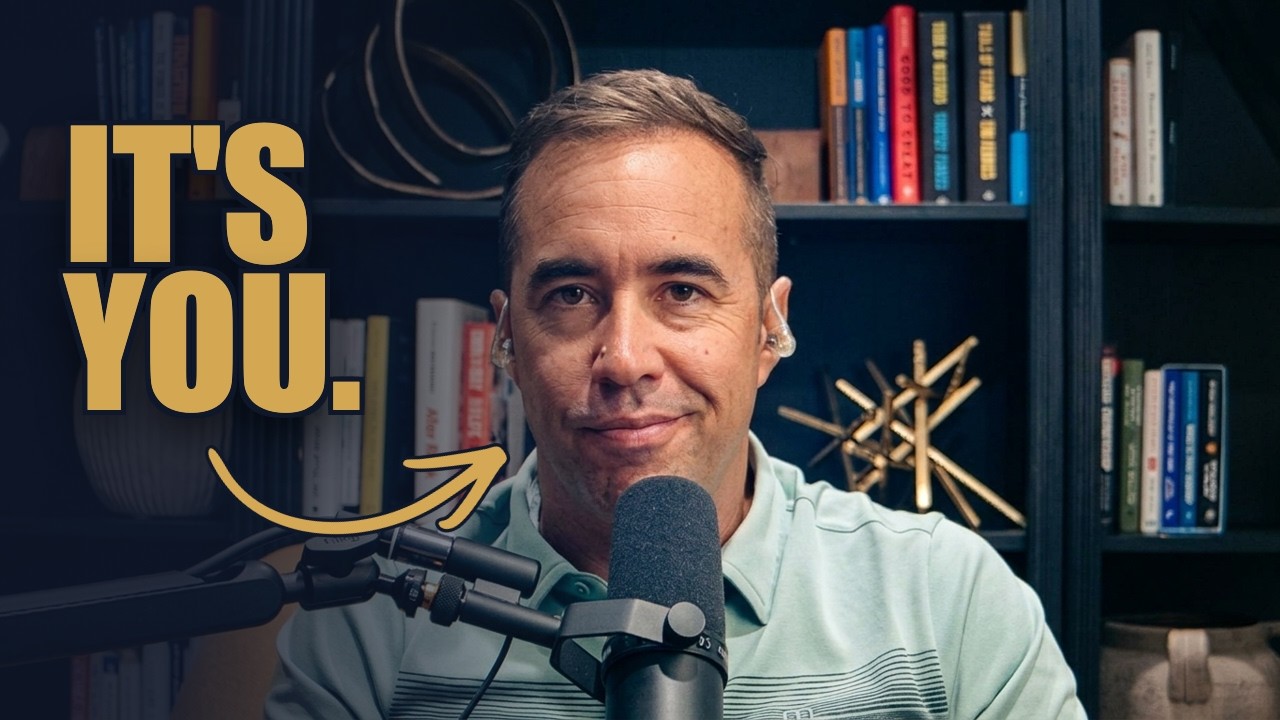
Ben Laws opens with a founder doing about $8 million a year and one question: if you vanished for the next 90 days, no phone, no email, no text, what happens to your business? The founder laughed, the kind of laugh you give a simple question with a complicated answer, because he already knew: it would fall apart. In this solo MaxLife episode, Ben makes the case that being the bottleneck isn't a systems failure. It's an identity you built on purpose, and it's quietly costing you money and freedom.
The 90-day test: would your business survive without you?
The question most entrepreneurs avoid, Ben says, is the one that points back at them. What a lot of founders actually built isn't a business, it's "a really expensive job that happens to sign 40 paychecks." If any part of you felt that in your stomach, that's the signal that your business can't run without you, and the real reason isn't the one you've been sold.
Why "you need better systems" is the wrong answer
Better systems, write the SOPs, hire an operator, build the org chart. All real, all force multipliers, and all things Ben tells you to do. But he's watched founders with full documentation and a complete leadership team stay the bottleneck anyway. Those moves are tactical and transactional. They don't touch the one decision underneath all of it.
Being needed vs. being valuable
"It was never about the org chart. It was a story you've been telling yourself about what being needed means." Somewhere on the way up, being needed started to feel like being valuable. Ben draws the line clearly: being busy is not the same as being productive, and being needed is not the same as being valuable. For years the business paid you to be the person with all the answers, the firefighter who swoops in. When you started, that was the whole job.
The hero-worship culture and the spine problem
Watch what happens when a founder tries to hand something off: they train someone, invest in them, and the second it isn't done exactly how they'd have done it, they jump back in and take it over. They call it quality. Underneath, Ben says, it's simpler and scarier: if the business runs fine without you, then who are you? What you've accidentally built is a hero-worship culture where everything flows through you and a little part of you loves the applause. Picture the business as a body. Right now you're the spine, and everything is load-bearing on you. Pull it out and the whole thing collapses. The goal was never to be a stronger spine. It's to build a body that can stand, walk, run, and jump without you holding it upright.
The version of you that has to die
To truly find freedom, Ben says, a version of you has to die. Every founder has a sacred cow. The one who needs to be needed for everything, first in and last out, wearing the exhaustion like a badge of honor, that person built the whole thing, and can't be the one who scales it or sells it. Letting the old you go won't feel like freedom at first. It feels like a guillotine cutting the oxygen to a part of your ego, and what follows is withdrawal. Ben's own story: when two-thirds of what he used to get applause for got taken away, he spent about 45 days feeling depressed and useless, asking "if I'm not this, then who the hell am I?" That's not weakness. It's what it feels like when an old self dies so a new one can show up.
What an owner-dependent business costs you at sale
This isn't only a feelings conversation. Eventually you'll want the business to go on without you, and a business that depends on its owner gets punished for it. Ben points to owner-independent businesses receiving acquisition offers around 71% higher than owner-dependent ones: same revenue, same profit, very different price. He describes an owner who doubled revenue over ten years but built everything around himself being needed, and got a valuation worth roughly half of what it should be. Every year you stay the spine, you're actively marking down the single biggest asset you'll ever sell, and living in a business that started as freedom and became a prison.
How to make your business run without you (start this week)
The reframe to leave with: the most valuable thing you could do this quarter is probably going to feel the most useless. You have to step back from something, with intentionality, not by chance, and not because you're checking out, but because you're finally willing to play a bigger game. Ben's homework: pick one decision that always runs through you, ideally the one you find most exhausting, and give it away completely. Not "run it by me first." Hand it over and pretend it never existed in your life. Then watch your gut. If it panics a little, good. You found the exact spot where your identity is still load-bearing. That panic is the map.